No. MUS2026-036
Pearl-shell churinga pierced to whirl
West Kimberley · Western Australia
Restricted
Source term: bull-roarer
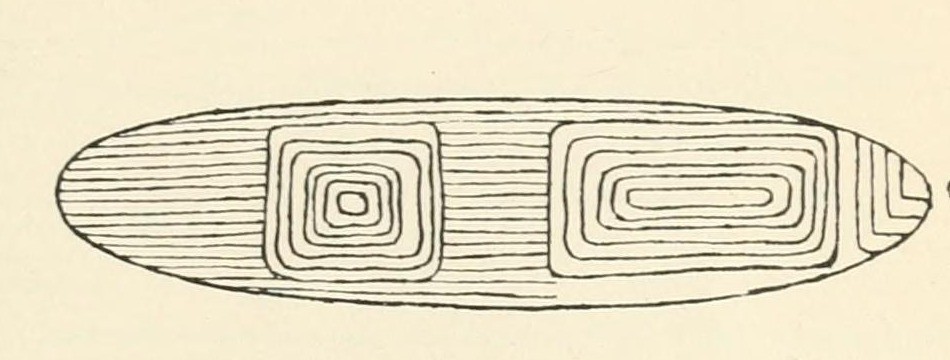
This shell and one other reached the Pitt Rivers Museum in 1924, bought from the dealer Emile Clement, who by then had residents of north-west Western Australia ship material to him in England to sell on to museums. They came in as "churinga of pearl-shell perforated like bull-roarers," from the Pidungu tribe of the Fitzroy River in the Broome district — engraved pearl-shell of the kind worn and exchanged across the western Kimberley and far beyond, here pierced so it could be whirled on a cord. The word "churinga" marks them as sacred and restricted to initiated men. Clement himself drew this form, and a drawing he made of an incised Kimberley pearl-shell survives. The Pidungu attribution and the object's function come down to us only through his sale notes, not through any record taken in the field.
Particulars
- Object
- A pearl-shell bullroarer of the Pidungu, its surface incised with geometric decoration and one end perforated.
- Function
- Pearl-shell pierced to whirl, and called churinga — the sacred, men's-restricted objects of the region.
Source
Pitt Rivers Museum, Oxford, acc. 1924.63.23; Pitt Rivers Museum Annual Report 1924, Accessions by Purchase (E. Clement)