MUS2026-224 - museum specimen
Fortescue River ancestor-design bullroarer pair
Fortescue River, Pilbara, Western Australia
Restricted
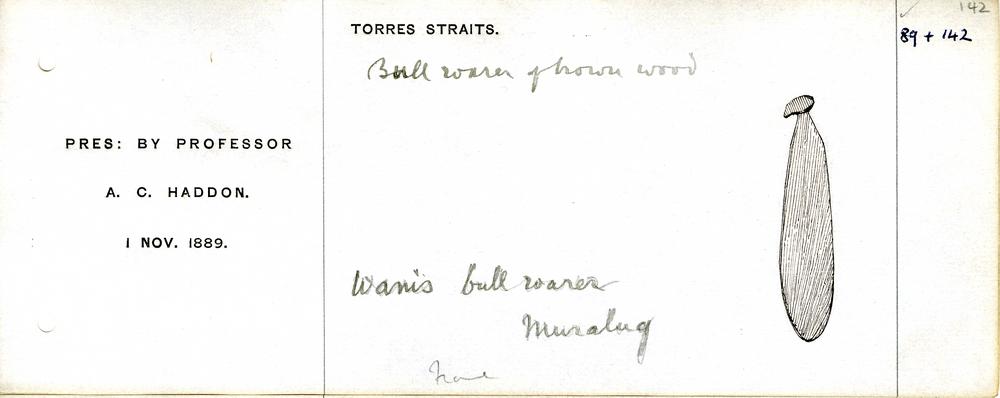
Source term: bullroarer or tjuringa (churinga)
A sacred design representing a totemic ancestor fills one face of each large wooden blade.
Large, wooden bullroarer, or tjuringa (churinga), with one face inscribed with sacred designs, which represent a totemic ancestor.
Museum of Archaeology and Anthropology, University of Cambridge, catalogue description for accession E 1915.20.5
- Object
- Two large wooden blades, each carved on one face with sacred designs representing a totemic ancestor.
- Function
- Not recorded.
- Source
- Museum of Archaeology and Anthropology, University of Cambridge, accessions E 1915.20.4 (object 492313, also MAA: AR 1915.290.4) and E 1915.20.5 (object 492314, also MAA: AR 1915.290.5), rowed once as a sibling pair; Description (.4): "large, wooden bullroarer or tjuringa (churinga), with one face inscribed with sacred designs, which represent a totemic…
- Source location
Page references
MAA E 1915.20.4 and E 1915.20.5 (objects 492313, 492314)
- Source confidence
- low to medium Anchor on the middle course of the Fortescue River, Pilbara, the only locality either record gives. The Fortescue runs some 700 km and no collecting camp, reach or crossing is named, so the point marks the river, not a site.