No. PNG11
Duo Yangoru
Papua New Guinea · East Sepik · Oceania · Sahul
Restricted
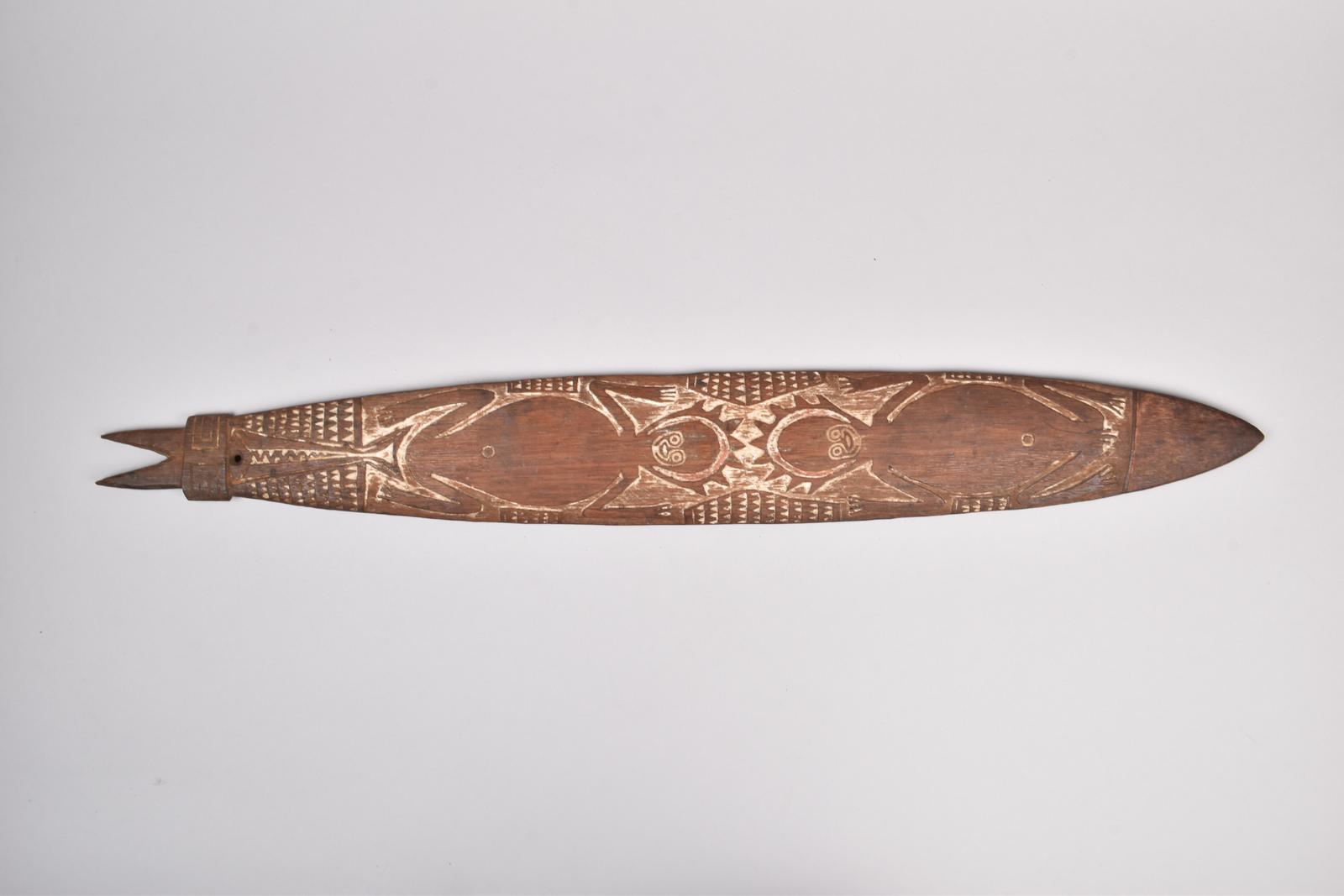
Among the Yangoru Boiken of the East Sepik foothills, the swung bullroarer was the voice of the wala — spirits believed to be formed from the mystical union of ancestral shades, some of them culture heroes now standing as the local mountains, others male and female spirits of the bush and stream. In former times, an important man's wife who insulted his sexuality was disciplined by "the wala": a band of men who came swinging the bullroarer and destroyed the couple's belongings. Bullroarers, along with weaponry and cooking and dining utensils, were sometimes incised with abstract designs the Boiken called the face of the wala. The culture was documented by the anthropologist Paul Roscoe, who spent about two years among the Yangoru Boiken at Sima village between 1979 and 1981.
Particulars
- Function
- Swung by men called “the wala” during punitive visits to an important man’s household.
Sources
- K. A. Gourlay, Sound-Producing Instruments in Traditional Society: A Study of Esoteric Instruments and Their Role in Male-Female Relations, New Guinea Research Bulletin 60 (Canberra and Port Moresby, 1975), p. 3, Table 1, p. 5, entry 11; citing A. P. Elkin (1956–57), p. 318 View
- Paul B. Roscoe, “Yangoru Boiken,” in Terence E. Hays (ed.), Encyclopedia of World Cultures, vol. 2: Oceania (Boston: G. K. Hall, 1991), pp. 388–391
- A. P. Elkin, “Australian and New Guinea musical records,” Oceania 27(4) (1956–57):313–319, p. 318, via Gourlay (1975), Table 1, entry 11