No. AUSMAIN-021
Roebourne bullroarer (SMVK)
Western Australia · Roebourne · Kimberley
Restricted
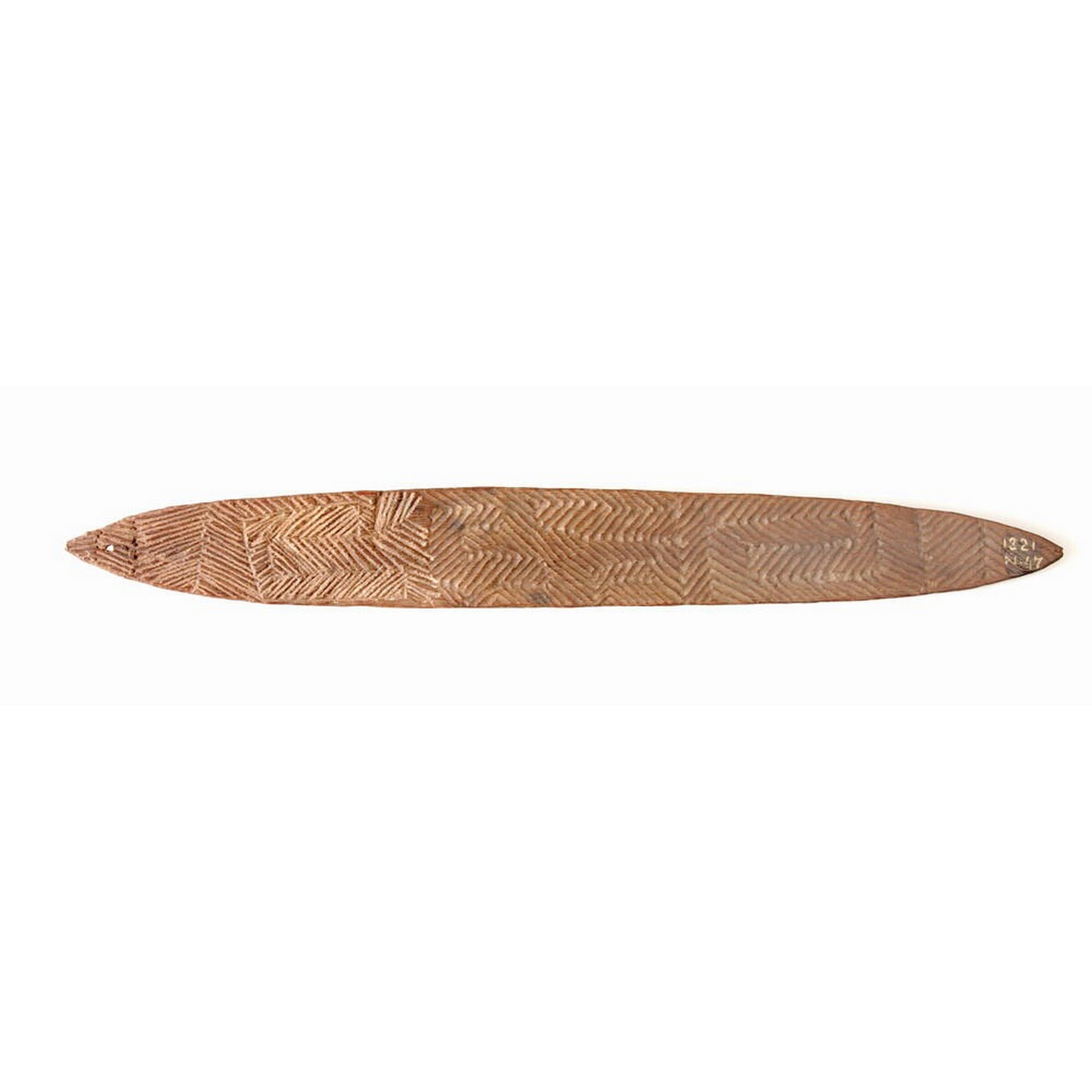
Source term: vinare, bullroarer
A carved wooden bullroarer collected at Roebourne, on Western Australia's Pilbara coast, and held by the Museum of Ethnography in Stockholm. It reached the museum in 1912 through the Swedish expedition to Australia of 1910–11 led by the biologist Eric Mjöberg, on which Yngve Laurell served as ethnographer and under whose name the collection is filed. In Stockholm it goes by "vinare" — the ordinary Swedish word for the instrument, from vina, to whizz or whine — paired with the English "bullroarer." Its makers and its rite went unnamed, but the museum now treats the set as restricted: in 2004 the Kimberley material-culture specialist Kim Akerman, reviewing the Stockholm collections, identified these Roebourne bullroarers as secret/sacred, and in 2019 the museum withdrew Australian objects of this kind from its Ursprungsfolk exhibition on its Oceania curator's advice.
Particulars
- Object
- Eight Roebourne bullroarers, SMVK 1912.01.1031-.1038, ranging from ornamented and red- or white-banded blades to unpainted or formerly painted examples.
- Function
- Secret and sacred; the ceremony it served was never recorded.
Source
Museum of Ethnography Stockholm / SMVK Carlotta object 1039402, accession 1912.01.1036; SMVK general catalog pp. 248-249, accessions 1912.01.1031-.1038