No. MUS2026-025
Mulga Downs cave-cached blades
Pilbara, Western Australia
Sacred / spirit
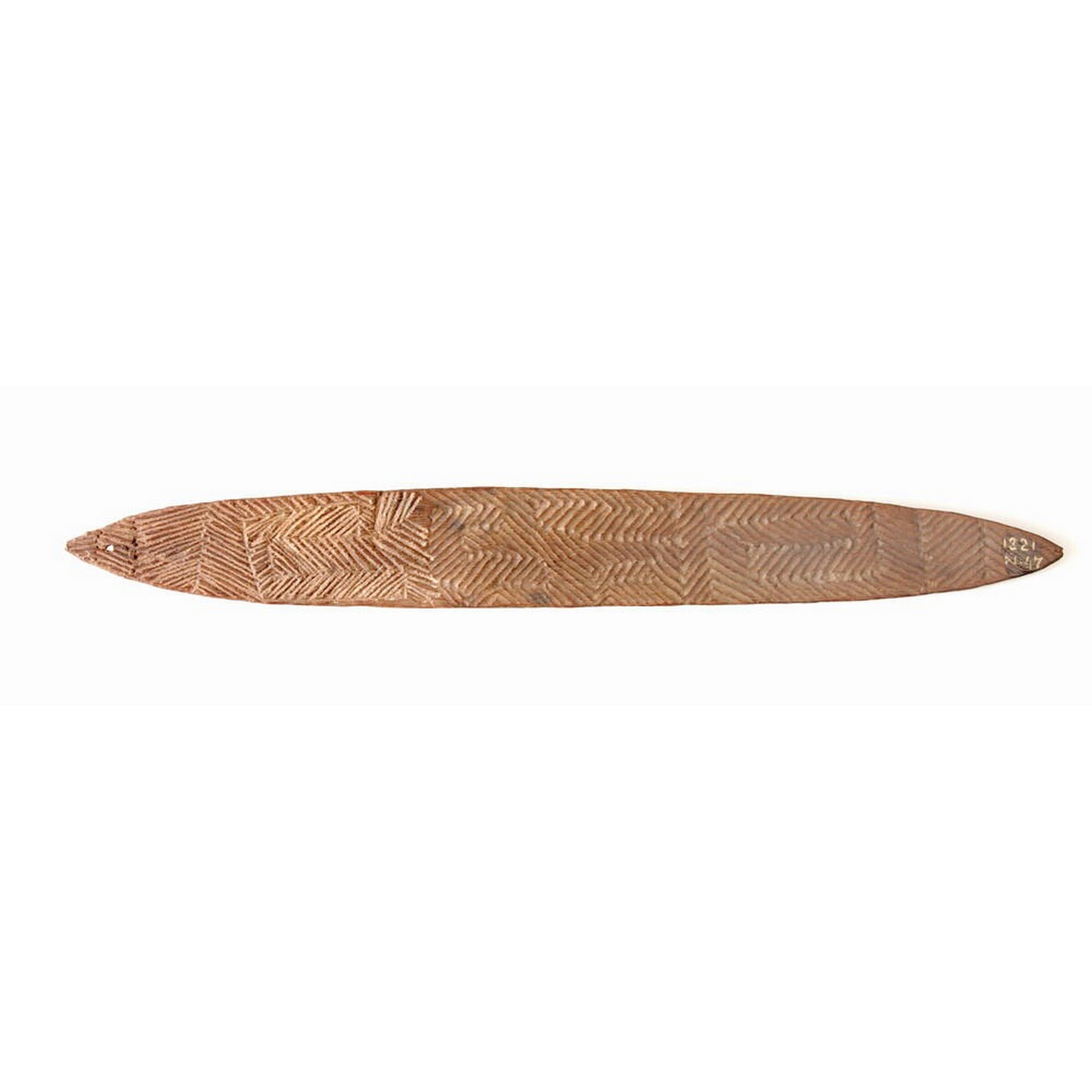
Source term: bull-roarer
A wooden bull-roarer, 44 centimetres long, lifted from a cave at Mulga Downs in the Hamersley country of the Pilbara — Banjima land — and given to the Penn Museum in 1943 by the American anthropologist Daniel Sutherland Davidson, who had collected it on his Australian expeditions of the 1930s. It is one of a set of nine Davidson catalogued from the same locality, and a companion churinga and bull-roarer from "Mulga Downs Cave" travelled on from Penn through Nelson Rockefeller's Museum of Primitive Art to the Metropolitan Museum. Emile Clement, who collected through this same country between the Fortescue and the Hamersleys in the 1890s, wrote down what such a blade was for: when a member of the tribe fell ill the boonangharries were set in motion while the doctor circled the sick person; at a death they were swung to drive away the djuno, who was the cause of every death; and through the circumcision camp they were violently swung to keep the evil spirit off.
Particulars
- Object
- Wooden bull-roarer, 44 by 9.2 centimetres, from a cave at Mulga Downs. Three more blades came from the same cave: a 49-centimetre blade carved with an interlocking key design, also at the Penn Museum, and two now at the Metropolitan Museum, a 50.8-centimetre bullroarer and a 117.5-centimetre board catalogued as a churinga.
Source
Penn Museum object 132843 (accession 43-4-110) and accession 43-4-106, gift of Daniel Sutherland Davidson, 1943; Metropolitan Museum of Art 1979.206.1535 and 1979.206.1537, Bequest of Nelson A. Rockefeller, 1979; Emile Clement, 'Ethnographical Notes on the Western-Australian Aborigines,' Internationales Archiv fuer Ethnographie 16 (1904), pp. 8-11