No. BATES1904-005
Meerudi, the Peak Hill magic board
Peak Hill magisterial district, upper Murchison–Gascoyne, Western Australia
Sacred / spirit
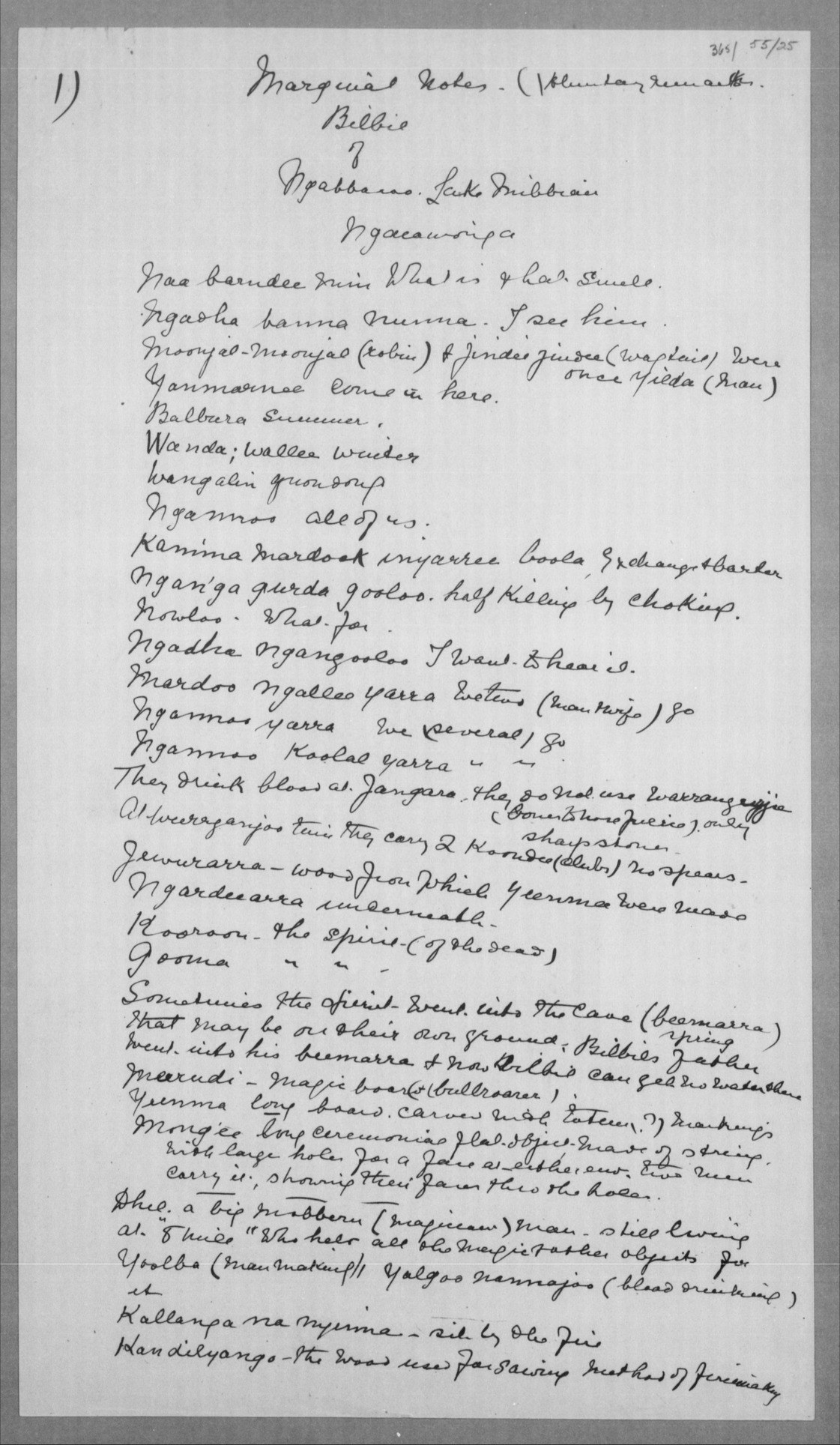
Meerudi; Mirudi
Source term: Magic board (bullroarer); Bullroarer
Meerudi / Mirudi: the bullroarer, "magic board". Yeenma / Yinma: the long carved board. Jewurarra: the wood the long boards were made from. beemarra: a spring.
Two men of the Peak Hill country gave the bullroarer almost the same name. Bilbil of Ngabbaroo, at Lake Mibbeean, called it Meerudi, the magic board, and kept it apart from Yeenma, the long board carved with totem markings and cut from a wood he named Jewurarra. Wajida listed Mirudi among the things men made, with spearthrowers, shields and the knife for circumcision, and gave the long narrow board pointed at both ends its own name, Yinma. Bilbil also spoke of the dead. A spirit, he said, sometimes went into a spring on its own ground; his father had gone into his, and since then Bilbil could see no water there.
Meerudi - Magic board (bullroarer).
Bilbil of Ngabbaroo, in Daisy Bates's vocabulary, NLA MS 365, folio 55/25
Particulars
- Object
- A bullroarer, called Meerudi or Mirudi, "magic board", made by men. It was kept distinct from the long carved board, Yeenma or Yinma.
- Function
- Called a magic board; its use is not recorded.