No. TORRES-002
Yam (Iama) Islanders
Australia · Yam (Iama) Island, central Torres Strait; territory of the Kulkalgal central-island people (Yam paired with neighbouring Tutu) · Oceania
Weather / fertility magic
bigu
Source term: bigu (large bull-roarer; the small form is wanes); the painted garden-charm slab was called madub or bigu
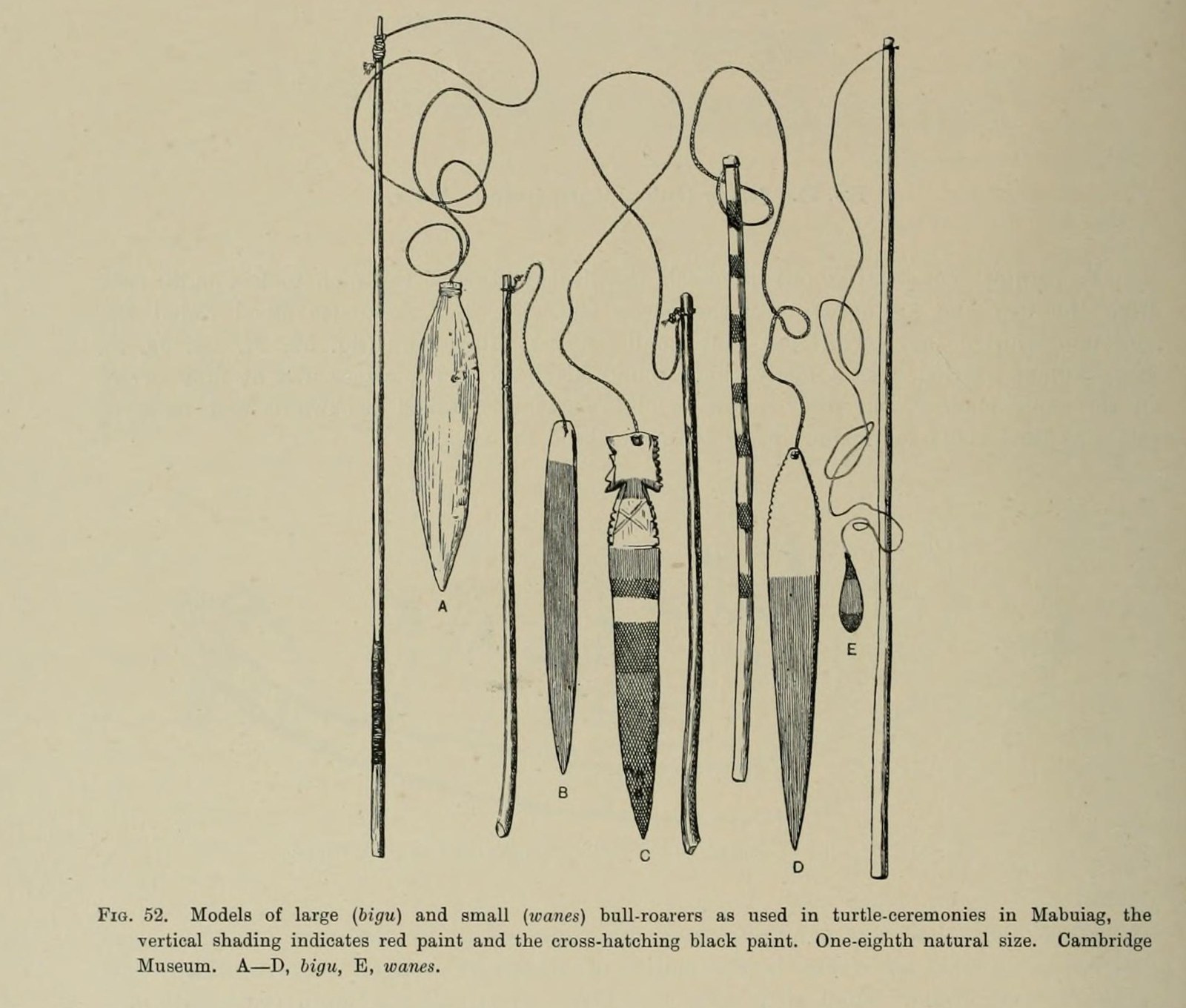
bigu — the western Torres Strait term for the large bull-roarer (the smaller form is wanes); at Yam the word also named a painted garden-charm slab, recorded interchangeably as madub or bigu.
Etymology. Lexically solid as the larger western Torres Strait bullroarer; at Yam the same word also labels a painted garden-charm slab.
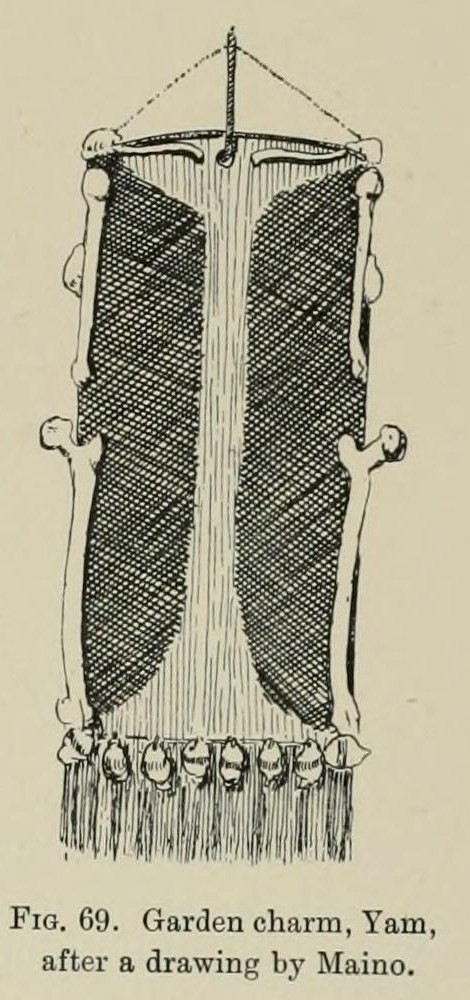
On Yam Island in the central Torres Strait, the bull-roarer was a tool of the garden and the hunt. Haddon recorded the large bigu — a flat slat swung round the head on a cord until it roared — as "belonging" to sweet-potatoes, yams, and turtle: whirled to make the crops grow and to aid the turtle catch. The headman Maino described a stranger object in the same family: a large oblong slab, painted black with a red central band and hung with human bones and white cowries, suspended from a shady tree in a secret place in the bush. Called madub or bigu, it plainly stood for a human figure; at night, islanders said, such garden charms "turned devil," came alive, and went among the plants swinging their bull-roarers while singing of the coming rain.
in Yam the same also occurred where the bigu "belonged" to sweet-potatoes and yams as well as to turtle.
A. C. Haddon (ed.), Reports of the Cambridge Anthropological Expedition to Torres Straits, Vol. V (1904), p. 347.
Particulars
- Object
- A flat oblong wooden slat (bigu) whirled on a cord round the head to roar and hum. Haddon distinguishes the large bigu from the small wanes, both whirled bull-roarers. At Yam a related large oblong painted slab — called madub or bigu — was hung from a tree in a secret bush place as a garden charm representing a human figure.
- Function
- Increase magic: the bigu "belonged" to sweet-potatoes, yams, and turtle — whirled to make crops grow and to aid the turtle hunt; a related painted slab (madub/bigu) was a hidden garden charm.
Source
A. C. Haddon (ed.), Reports of the Cambridge Anthropological Expedition to Torres Straits, Vol. V: Sociology, Magic and Religion of the Western Islanders (Cambridge University Press, 1904), section "Magic and Religion," p. 347 (madub / bigu at Yam, fig. 69); turtle-magic bull-roarer use described pp. 330-331