No. AUSMAIN-029
Mara (Marra)
Australia · Coastal country around the mouth of the Limmen Bight River, southwest Gulf of Carpentaria, between the Roper River and Maria Island, Northern Territory
Restricted
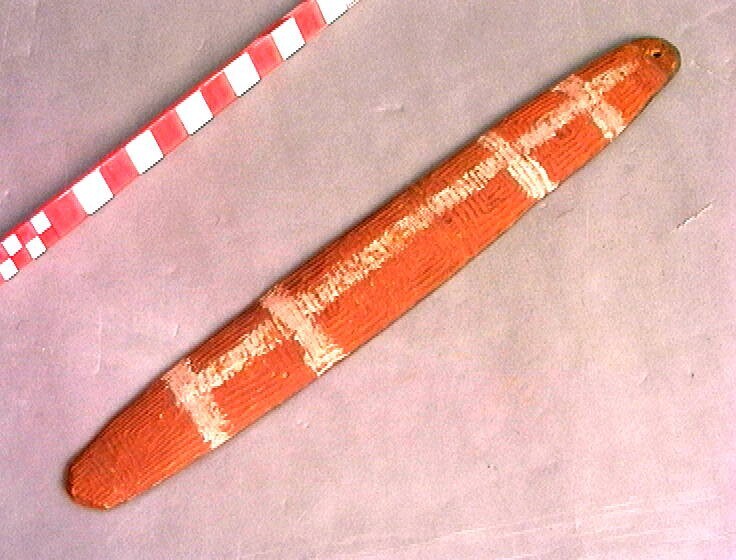
watanurra
Source term: watanurra (also watamura)
watanurra (also watamura): the sacred whirled slat / bull-roarer of the western-Gulf coastal tribes; Spencer & Gillen equate it with the Churinga of the inland Arunta, and note the Anula call it mura-mura.
Etymology. The sacred stick whirled at circumcision among the western-Gulf coastal tribes, recorded by Spencer and Gillen in their Binbinga account (watanurra, in chapter XVI watamura, with Anula mura-mura) and equated by them with the churinga of the inland Arunta; they state that the Mara ceremonies are practically identical. Women and children took the roar for the voice of a swallowing spirit — Katajalina among the Binbinga, Gnabaia among the Anula — and no literal meaning of the term is given.
Among the Mara of the Limmen Bight River country, on the western shore of the Gulf of Carpentaria, the bull-roarer belonged to the making of men. Spencer and Gillen, who worked this coast on their 1901-02 expedition, grouped the Mara with their neighbours the Binbinga and Anula as three tribes whose initiation rites were 'practically identical.' As a boy was held down for circumcision, the sacred slat called watanurra was 'twirled round and round to make the roaring noise' — a sound the women and children were told was the voice of a spirit that lived in an ant-hill, came out to eat the boy, and afterwards restored him to life. The slat was then placed on the novice's open palms, and he was given a small one of his own to carry through the bush until his wound healed, warned that if any woman or boy caught sight of it he and they would die, and told that he must keep swinging the stick.
Amongst the coastal tribes, the Binbinga, Anula, and Mara, the initiation ceremonies are again closely similar to those of the inland tribes... The women and children on their part think that the noise of the bull-roarer is made by a spirit whom they call Katajalina, who lives in an ant-hill and comes out and eats the boy up, restoring him subsequently to life.
Spencer & Gillen, The Northern Tribes of Central Australia (1904), p. 501
Particulars
- Object
- A flat sacred slat, twirled on a cord to make a roaring noise during the circumcision initiation; a true whirled bull-roarer, not a buzz-disc, rattle, or struck idiophone.
- Function
- Whirled at male circumcision initiation; its roar is presented to women and children as the voice of a swallowing spirit that devours and revives the novice, who is then given a small one to carry hidden in the bush until his wound heals.
Source
Spencer, Baldwin & Gillen, F.J. (1904). The Northern Tribes of Central Australia; London: Macmillan; Ch. XI (Initiation Ceremonies), pp. 363-367; Ch. XVI (Beings Endowed with Superior Powers), pp. 500-503