No. HAYS1986-009
Menya roarer and the pierced septum
Papua New Guinea · Menyamya district · Angan language region · Oceania · Sahul
Restricted
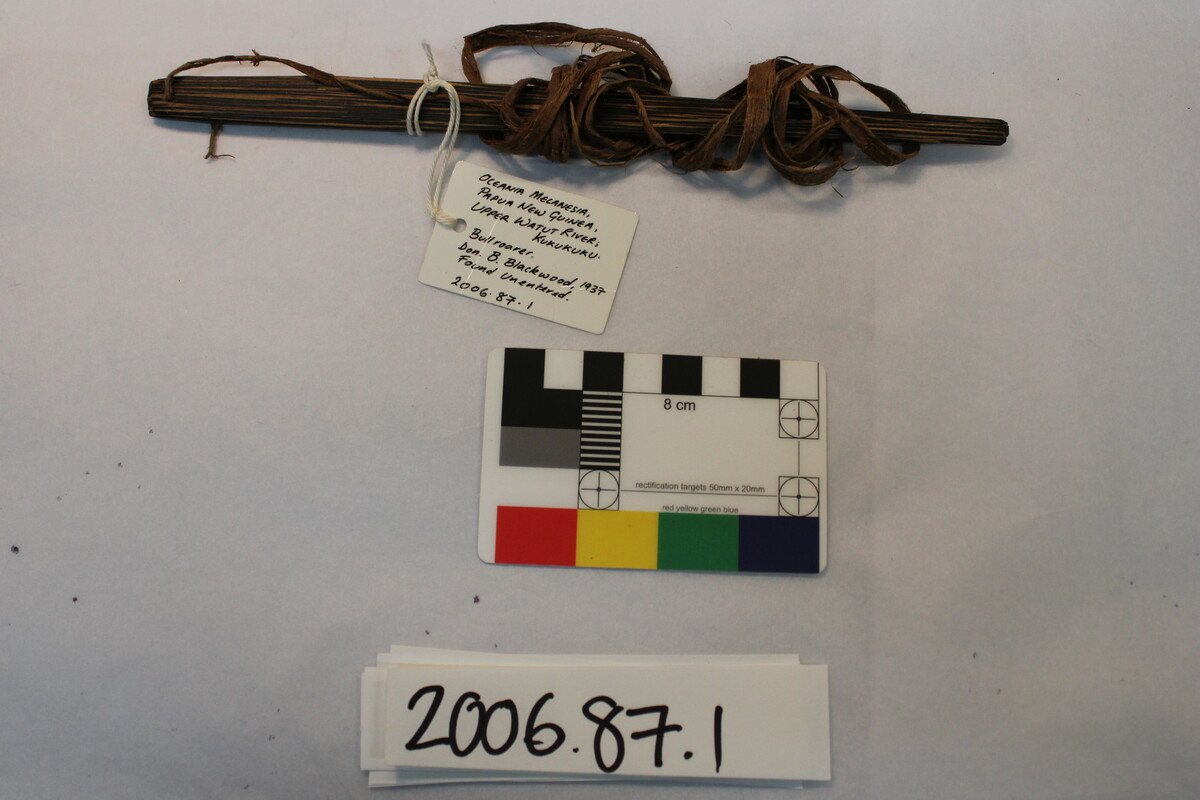
Source term: bull-roarer
The Menya kept no sacred flutes: in the Highlands survey where nearly every men's cult to their north and west turned on paired bamboo, theirs ran on the bullroarer alone. Like their Angan neighbours in the mountains between the Eastern Highlands and the Morobe and Gulf watersheds, they timed its disclosure to a permanent change in the body — boys learned what the roaring was in association with the piercing of the nasal septum, so that the knowledge and the hole through the nose arrived together.
bullroarers were the secret instrument revealed to young boys, in association with septum-piercing, in Kapau, Menya, and Wojokeso
Hays 1986:443 (Anthropos 81), citing Simpson 1953:102–105 for Menya
Particulars
- Object
- A bullroarer revealed to Menya boys at initiation.
- Function
- The secret instrument revealed to young boys at initiation, in association with the piercing of the nasal septum.
Source
Terence E. Hays, 'Sacred Flutes, Fertility, and Growth in the Papua New Guinea Highlands', Anthropos 81 (1986), pp. 436, 443, citing Simpson 1953, pp. 102–105