No. LOEB1929-003
Yuin Daramulun voice bullroarer
Southeastern Australia · Southeast
Restricted
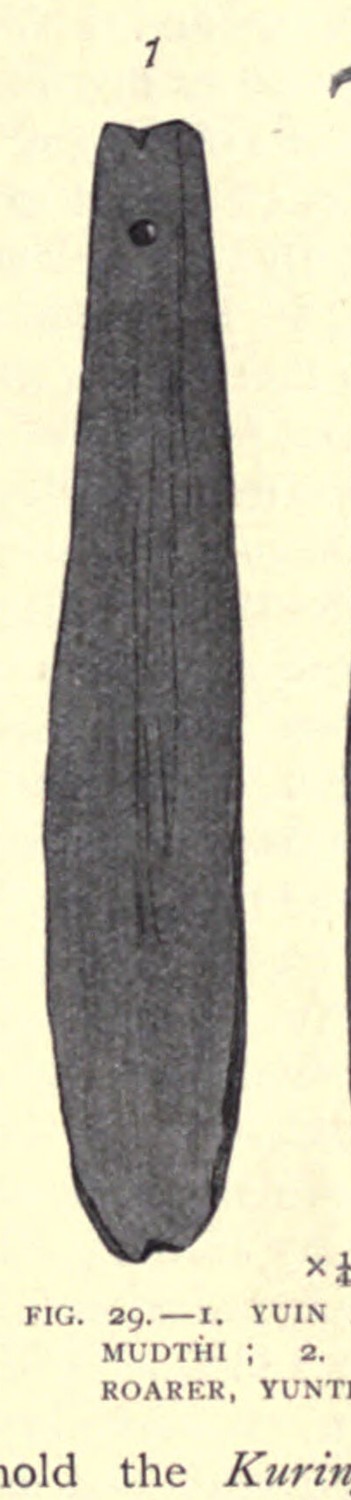
Mudthi
Among the Yuin of southeastern Australia, the whir of the bullroarer was the voice of Daramulun, the sky-being who, in Howitt's record, lived beyond the sky and watched what the Murring did. Howitt, who documented the Yuin Kuringal initiation at Bega in 1883, wrote that the roaring of the instrument the Yuin called the Mudthi stood for the muttering of thunder, and the thunder was the voice of Daramulun. The sound could be sent across to the initiated at the Bunan camp while being masked from the women and children, who were not to know its source. At the climax of the rite the novices, having had a tooth knocked out, were led by their guardians to a tree on which the figure of Daramulun had been cut, and were told of him and his powers. They left under a flat warning: make anything like that back in camp, and you will be killed.
The roaring of the Mudthi represents the muttering of thunder, and the thunder is the voice of Daramulun, and therefore its sound is of the most sacred character.
Howitt 1904, The Native Tribes of South-East Australia, p. 538
Particulars
- Function
- Bullroarer is the voice of Daramulun and part of initiation disclosure.
Source
Loeb 1929, Tribal Initiations and Secret Societies, University of California Publications in American Archaeology and Ethnology 25(3):249-288, citing Howitt 1904, The Native Tribes of South-East Australia, p. 538