No. ROTH1902-001
Gungganyji Cape Grafton roarer
Australia · Cape Grafton · Jilliburri, North Queensland
Play / practical
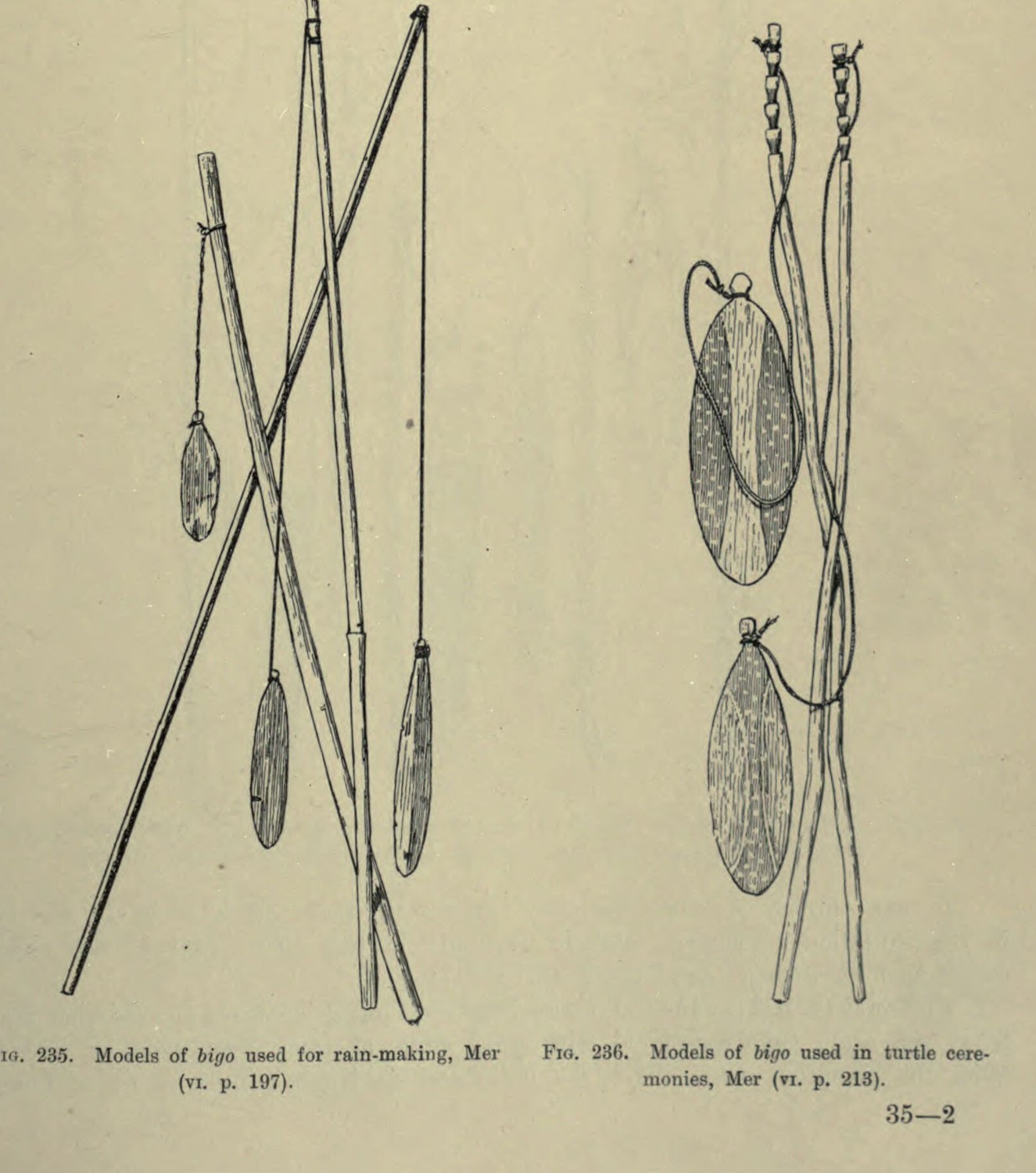
At Jilliburri — the granite headland Europeans renamed Cape Grafton — the roarer belonged to young men and boys alone. Roth, surveying games across North Queensland, filed it among 'amusements derivable from ceremonial': a flattened spindle of plain wood, three to six inches long, spun hard on its string and given a sudden extra jerk to make it roar. In the northwest-central districts anyone might whirl one, either sex, any age; on this coast the old line held — men and boys only.
On the Bloomfield, Lower Tully, and at Cape Grafton they are employed by young men and boys only.
Walter E. Roth, Games, Sports and Amusements (1902), p. 500
Particulars
- Object
- Flattened spindle-shaped wooden slat, 3-6 inches, an aperture drilled at one extremity for a string held in the hand or fixed to a small stick; rapidly revolved to roar, never engraved, sometimes painted. No Cape Grafton specimen was collected; Roth's Plate XXVIII figures are generic North Queensland types.
- Function
- An amusement Roth filed as 'derivable from ceremonial': at Cape Grafton, as on the Bloomfield and Lower Tully, it was employed by young men and boys only, while in the northwest-central districts either sex played it at any age.
Source
Walter E. Roth, Games, Sports and Amusements (North Queensland Ethnography Bulletin 4 = AAAS Section F presidential address, 1902), p. 500; Kate Khan, Technical Reports of the Australian Museum 12 (1996), p. 68