Kunapippi, serpent and Mother traditions across the north
Across the Roper, Arnhem Land and Daly River ceremonial worlds, named sacred boards announce ancestral presences and bring novices into guarded knowledge. Kunapippi, Gunabibi and Karwadi link revelation, custodianship and transformation; their founders, swallowing beings and histories of ownership remain locally distinct.
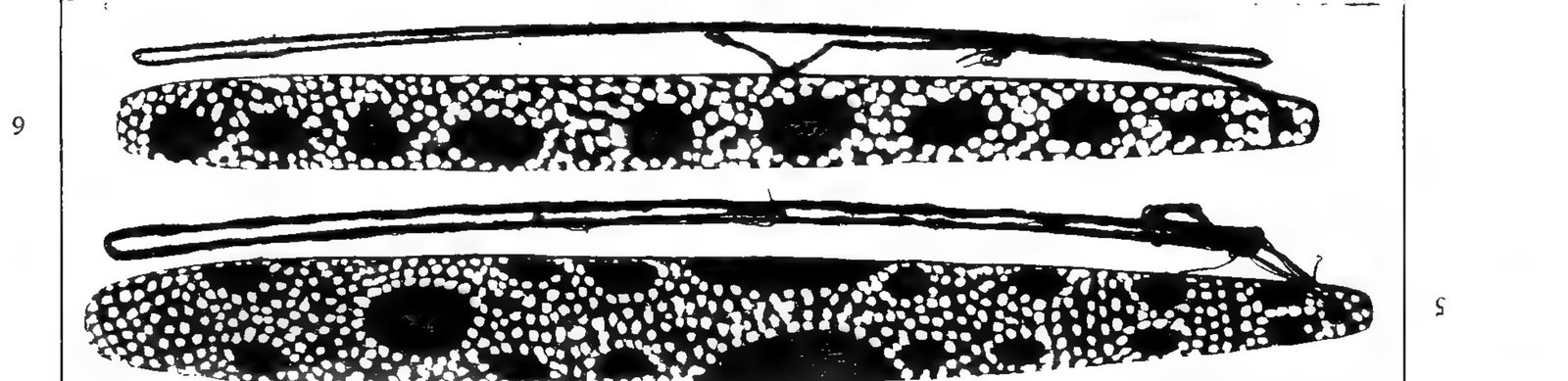
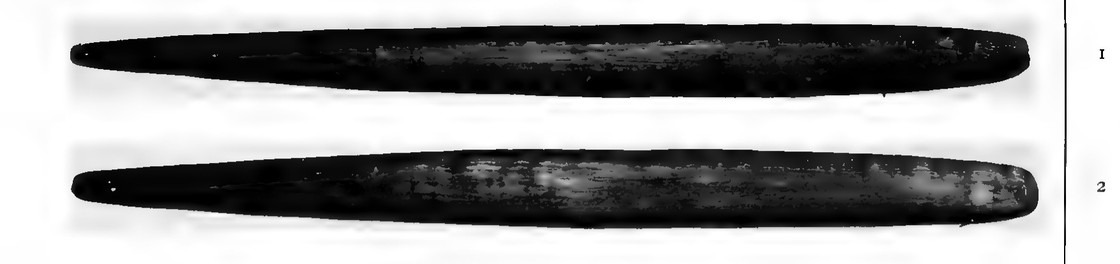
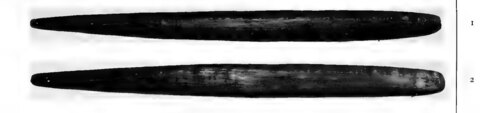
MungaraiSpencer's plate of the Mungarai kunapippi.Spencer, Native Tribes of the Northern Territory (Macmillan, 1914), Plate II · Public domainNgalakan (Spencer's Nullakun)Nullakun kunapippi pair, Spencer 1914, Plate II figs. 1–2.Spencer, Native Tribes of the Northern Territory (Macmillan, 1914), Plate II figs. 1-2 · Public domain
The roar grows nearer. Older men cry that Karwadi, the Old Woman, is calling. Then the hidden swingers spring into view, and each Murinbata novice receives a new bullroarer from a prospective brother-in-law. That passage from ancestral voice to inherited object is a defining northern pattern: a frightening presence approaches through sound, and the young man emerges with a place among its custodians. 3
One ceremonial grammar, several ancestral presences
Kunapipi and Gunabibi traditions give the roarer a place in a wider drama of ancestral life. In the Nunggubuyu museum account, the voice belongs to Ngara-Mamurna, the mythical woman who swallows the initiands; Gunabibi is primarily identified with the Mandayung moiety. Warner’s Yolngu account makes the instrument the voice of the great python Yurlunggur. Stanner’s Murinbata Karwadi is the Mother of All. In each, a presence heard at a distance bears directly on the transformation of novices, while the names and identities belong to their own communities. 6, 3, 7, 9
The published Wawaluk account makes this particularly concrete: the blade is the serpent’s body, the hair cord its fangs, the roar its voice. Mathaman Marika’s bark painting maps the sisters’ approach to the sacred lagoon and inventories the ceremony’s artefacts. The python-painted Yolngu board and the long Milingimbi blade with its surviving human-hair cord show two material forms within this Arnhem Land field of ancestral sound. 5, 6, 8
Spencer’s Mungarai founder is a very big man named Kunapippi, with many dilly bags full of spirit-children, all boys. He brings them out onto grass within a raised-bank camp, gives them their class and totem identities, decorates them and teaches the ceremonies. He carries one of his namesake sticks when he hunts, sounding it as he returns to tell the children he is near. The first roarer thus belongs to a founder who organizes kinship, food, performance and initiation together. 1
His story also has a terrible turn. Kunapippi kills and eats visiting men, then is killed by their avengers; two of his own boys are recovered alive when his body is opened. His children join the strangers, teach the rites and retain the sticks. Spencer separately records a woman of the kunapippi totem travelling with wrapped instruments. She joins women’s ceremonies until Kumkum watches them, uncovers the hidden boards and takes them away. These two Mungarai tellings explain ancestral instruction and present male possession without being made into one composite tale. 1
Among the Djauan, Spencer records Kunapippi or Kunabibbi being revealed after circumcision, then preserved in places known to old men. The neighboring Ngalakan first see their kunapippi at a later initiatory stage, after their guardian has covered their eyes and ears; women hear Mumanna’s voice in its noise. The same instrument-name connects these testimonies, but neither acquires the Mungarai founder’s biography merely by sharing it. 1
At Murinbata Punj, the youths are made nameless, stripped of ornaments and covered with blood. They have been told that Karwadi will swallow and return them. The moment of disclosure reveals the swingers and the human source of the blood together; the new boards make a lasting relation between each youth and the man who gives him one. Stanner also records Mutjingga’s separate story: she swallows ten children, two men kill her, and the children are cut alive from her womb, washed, decorated and returned. He explicitly examines the relationship between that story and the rite, whose details do not match at every step. 3
These institutions moved as well as persisted. Stanner traced young Nanggumiri men bringing the Kunabibi–Karwadi cult from Victoria River country to the Daly in the 1920s. He placed its arrival amid people’s conviction that their All-Father Angamunggi had gone away: the All-Mother offered renewed authority and continuity. Durmugam was one of three central men in the movement. In 1978 Stanner returned three old boards, including Durmugam’s gift, for a Punj ceremony at Peppimenarti. 4, 3
An earlier eastern testimony gives another point in the family’s history. In 1904 Spencer and Gillen recorded kunapipi as the Anula name for sacred ceremonies and watched a bullroarer clear the ground before an Ulanji snake-totem performance. That is a named early ceremonial link; the later Mother cult’s whole mythology cannot simply be read backward into it. Across the network, the secure resemblance is the combination of ancestral sound, guarded revelation, transformation and the right to keep and transmit the instruments. 2, 1, 3
Among the Mungarai of the middle and upper Roper River, in the country east of Mataranka, the bull-roarers were called Kunapippi, after the ancestral being who first owned them. Baldwin Spencer, who recorded the tradition during his 1911-12 fieldwork, found them considerably larger than those of…
Among the Murinbata of the Port Keats region, the bullroarer (ngawuru) is the emblem of Karwadi, the secret name of a spirit also called The Mother of All or The Old Woman, and the roaring sound it makes when swung is held to be the sign of her real presence. The anthropologist W. E. H. Stanner,…
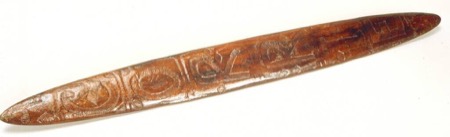
Representative — not this record’s object · A wooden board carved end to end with concentric scrolls and key-pattern.
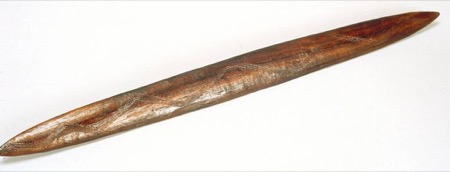
This python-painted paddle is not a picture of the great snake Yurlunggur — swung hard on its cord, it is his voice. The men of Arnhem Land told the women that the whirring roar was the serpent crying out in hunger, and that any woman who came near would be swallowed whole. At initiation the men…
In the 1920s the people of the Daly River became convinced that Angamunggi the All-Father — their form of the Rainbow Serpent — had deserted them. Barren women, spreading sickness, dwindling game: proof, people said, that he no longer looked after them; Stanner was told simply that Angamunggi had…
Spencer, Native Tribes of the Northern Territory (Macmillan, 1914), Plate II figs. 1-2 · Public domain
At the last stage of a Nullakun man's making, his guardian kinda clapped both hands over the new bandari's eyes and ears at a special camp out in the bush. Men decorated with birds' down performed the totemic ceremonies of his own sub-class, and then — for the first time in his life — he was…
What the Wereldmuseum holds here is not a bull-roarer but the cord that swings one: a length of twined human hair, the handle by which a Nunggubuyu man set the wooden plate roaring. The sound it made was the voice of Ngara-Mamurna, the mythical woman who, in the museum's account, swallows the…
Representative — not this record’s object · A board carved with fine diagonal chevron patterning.
pp. 222–224, 275–277, 351–353, 366–373, 420–421, 434–435, 498–503. Anula kunapipi is an early local ceremony-name, not proof of every feature of later Mother cults.
Reprinted in White Man Got No Dreaming (1979), pp. 83–86, particularly p. 84 for Victoria River–Daly transmission and p. 86 for Lam utji’s obligation. The returned Peppimenarti instruments appear in the 2014 On Aboriginal Religion editors’ introduction, p. xxxiii.
Art Bulletin of Victoria 29; NGV republication 18 June 2014. Published account of Wawaluk ceremony, serpent blade/body/string/voice and Mathaman Marika’s 1963 Arafura Lagoon. No particular painted mark is identified as a bullroarer.
Murngin Totemism, revised edition p. 281 and associated Yurlunggur initiation passages. The voice identifications Wirtit/Yurlunggur/Muit belong to Warner’s Yolngu account.
Exact object account: human-hair swing cord, Ngara-Mamurna voice and Gunabibi. This supplies the Nunggubuyu-specific voice identity; van der Leeden separately documents the ceremony’s primary Mandayung identification.
Exact surviving blade, human-hair cord and handle; E387549-0. Locality and object form; Warner supplies ceremonial context rather than an exact specimen rite.
Explorations in the Anthropology of Religion, printed p. 154: Gunabibi’s primary identification with Mandayung, with reciprocal ownership and management. The identification is expressly not absolute.