No. AUSIN-009
Flinders River Mycoolon mobolah
Australia · North Queensland · Gulf country
Restricted
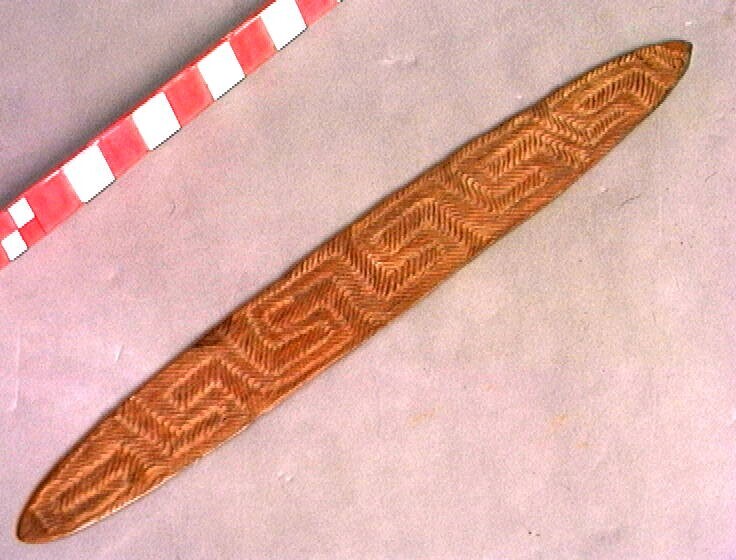
Mobolah
Mobolah: the Mycoolon name for the bullroarer or "humming stick," a flat wooden blade swung at Bora to keep women and the uninitiated away.
Among the Mycoolon of the Flinders River in Queensland, the bullroarer was a "humming stick" called mobolah, brought out at Bora times only: a flat piece of wood about nine inches long and two inches broad, thin, and tied to another stick. Its purpose, as the pastoralist Edward Palmer recorded in 1884, was "to warn the gins not to approach"; no woman was ever to see it, nor any uninitiated youth. R. H. Mathews quoted Palmer's account in his 1898 survey of Australian bullroarers, where it stands among forms gathered from widely separated parts of the continent—Port Lincoln, the Wiradjuri country, Lake Eyre, the Kimberley—each tied to initiation.
At the ceremony the boy's arms are tied tightly with a string till they swell, and he is then kept two days without anything to eat; water is given, but no food.
E. Palmer, "Notes on Some Australian Tribes," Journal of the Anthropological Institute 13 (1884): 295
Particulars
- Object
- Humming stick used at Bora to warn women not to approach
- Function
- Bora-associated bullroarer with explicit taboo on women and uninitiated youths seeing it
Source
R. H. Mathews, 'Bullroarers Used by the Australian Aborigines,' Journal of the Anthropological Institute 27 (1898), p. 54, quoting E. Palmer, 'Notes on Some Australian Tribes,' Journal of the Anthropological Institute 13 (1884), p. 295