No. AUSIN-025
Gascoyne Mooryumkarr spirit-chaser
Gascoyne · Western Australia
Sacred / spirit
Mooryumkarr
Source term: Mooryumkarr / bull-roarer
Mooryumkarr: historical Gascoyne name; Giglioli glossed it in Italian as scaccia-spiriti, ‘spirit-chaser.’
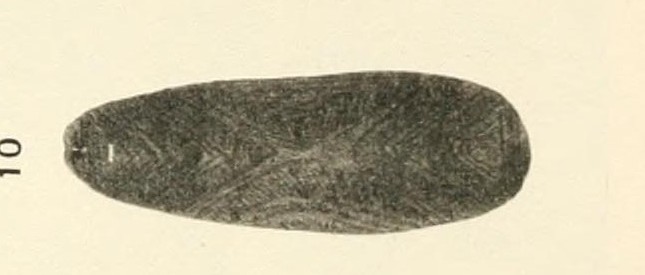
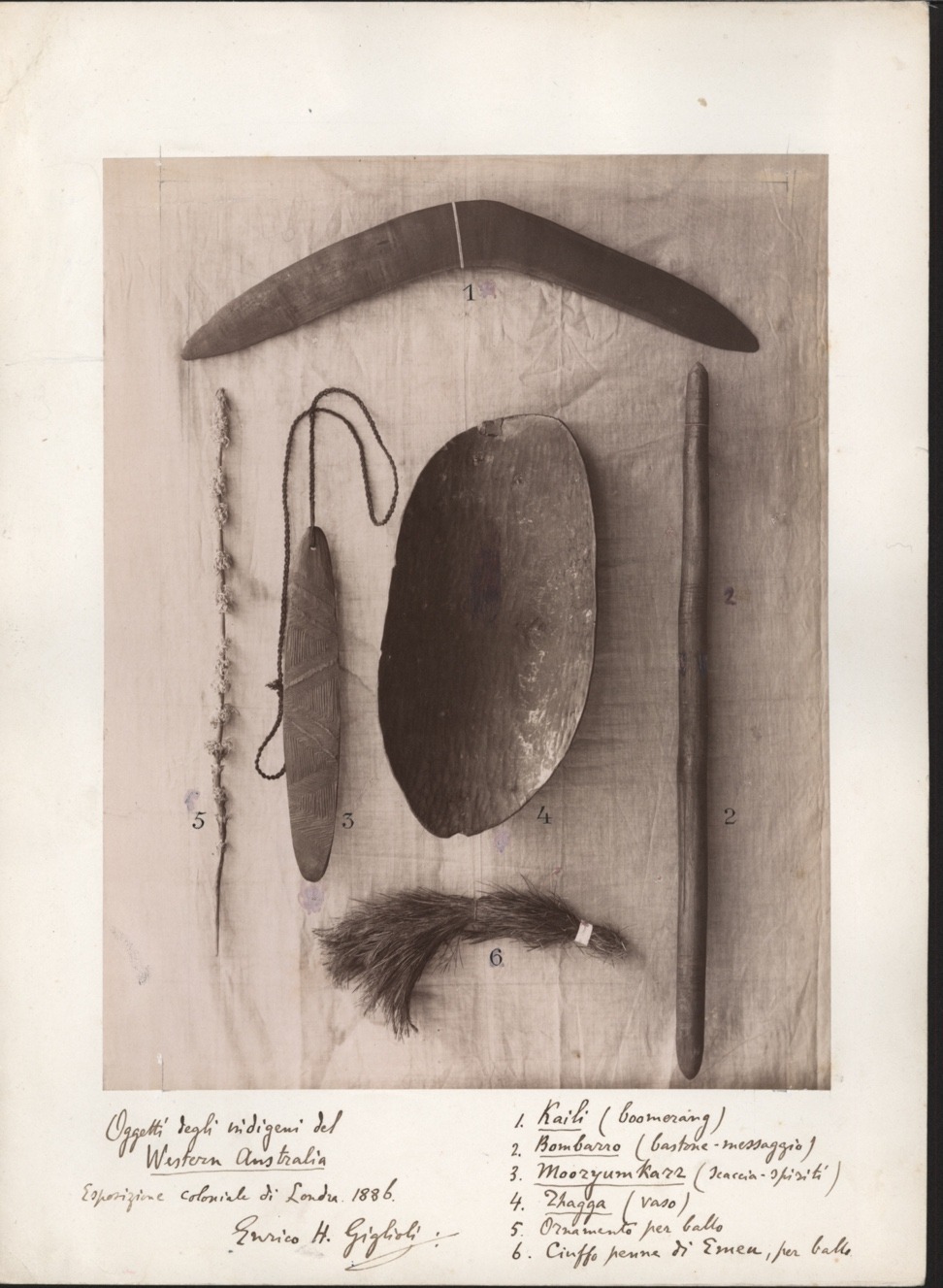
At the mouth of the Gascoyne, an incised oval board on a human-hair cord was called Mooryumkarr — "spirit-chaser." It travelled to London for the 1886 Colonial Exhibition with its cord still attached and its name written beneath it. A second Gascoyne blade, dense with cross-hatching, later reached Chicago's Field Museum.
Mooryumkarr (scaccia-spiriti)
Mooryumkarr (spirit-chaser)
Giglioli, handwritten caption to the Western Australian objects photographed at the 1886 Colonial Exhibition, object 3
Particulars
- Object
- Incised oval wooden Mooryumkarr on a human-hair cord, photographed at the 1886 Colonial Exhibition; a second cross-hatched Gascoyne bullroarer is Field Museum catalog 173152.
- Function
- Giglioli glossed Mooryumkarr as a spirit-chaser; no specific rite is recorded for either Gascoyne object.
Source
Giglioli, handwritten caption to the Western Australian objects at the 1886 Colonial Exhibition, object 3; R. Pettazzoni, ‘Un rombo australiano,’ Archivio per l'antropologia e la etnologia 41 (1911), p. 257 n. 1 (Giglioli collection no. 50); W. D. Hambly, Primitive Hunters of Australia (Field Museum, 1936), Plate I, fig. 10 (Field Museum cat. 173152)