No. MUS2026-371Australia
Aritunga, one large and one small
Australia · Hermannsburg region, Northern Territory · Central Australia
Sacred / spirit
- Spirit voice
- Snake-linked
- Initiation rite
- Death and rebirth
- Forbidden to women
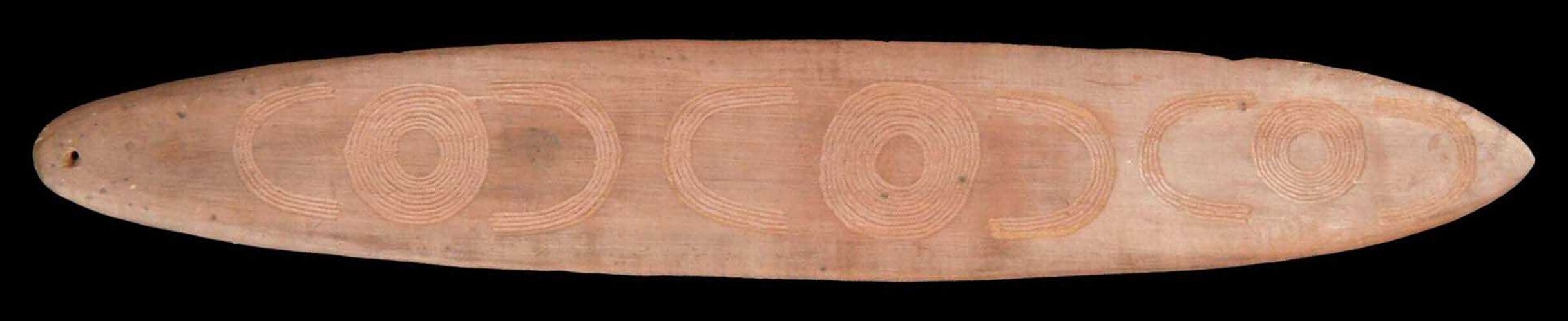
aritunga
Source term: Rhombe
aritunga: the vernacular name recorded for the larger blade. Tuanjiraka (Strehlow's spelling; Arrernte Twanyirreke): an ancestral being, and the name a novice is told to give the large bullroarer, which is otherwise called nankara.
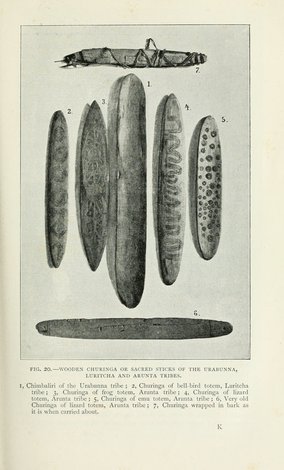
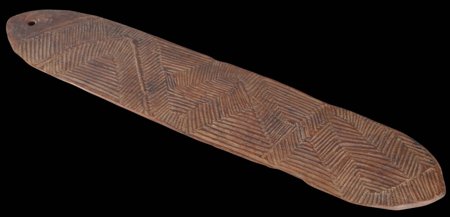
In Rubuntja, a place in the northeast, there once lived many small men called Tuanjiraka, who cut off their right leg with stone knives and carried it over the shoulder on their journeys. One of them killed an echidna and a large lizard, took the echidna's skin for his shield and the lizard's tail for his stick, and then “looked for many living snakes, which he wound around his head, neck, arms and body.” When a boy is to be circumcised he is brought to this Tuanjiraka, who tells him to look up to the stars and strikes his head off with the lizard's tail, “so that it rolls far across the ground.” At midday the next day, “when the boy's body has become full of maggots and stinking,” Tuanjiraka puts the head back on and the boy comes alive again; Tuanjiraka circumcises him himself. “When the women or children hear the voice of Tuanjiraka [the sound produced by the bullroarer], they run off in fright.” Far to the south-east the Wiradjuri of New South Wales told strikingly close stories of Daramulun, who was also lame or one-legged, so close that Strehlow's editor judged in 1908 that the two must somehow depend on each other. An Aranda boy's road to the secret began when an elder brother led him away from his mother's camp, a seizure called erakintjilama, 'making ashamed': the shame to be woken in him was that he would keep clear of women and older girls from then on. Tuanjiraka “has a wife called Melbata and many children who are called nankara [nankara is also the name of the large bullroarer]. After the circumcision, a bullroarer of this kind is shown to the rukuta with the words: This tjurunga you shall call Tuanjiraka.” Strehlow files the tale among the Aranda fairy tales, which unlike the legends are also told to women and children, “either to keep them from trying to penetrate the secrets of the men [see the tale of Tuanjiraka]” or to frighten them (I p. 101). His Loritja counterpart is Maiutu: Strehlow glosses the place-name Maiutukunna as “the excrement of Maiutu = Tuanjiraka of the Aranda” (I p. 74). At the circumcision two men each took up a large nankara and set it humming, and the women and children took flight. Soon after the cut the men put several nankara in the novice's hands and told him it was Tuanjiraka: "this is he who gave you the pain." Then they handed him the lie. The women and children had been told only of the tjurunga, they said, and Tuanjiraka was set beside it as a likeness; the boy must keep telling the children that he exists, "else all would vanish from the earth." Let the message out, and "you would lie mortally sick. Like us, you must falsely say: Tuanjiraka surely exists." Strehlow adds that the blade is not mere wood: the boy is to regard it as the body of his altjira, his maternal totem ancestor, who will go with him on his solitary wanderings. His Foreword to the 1907 myths says the same of every tjurunga, that it “counts as the ‘hidden body’ of the ‘totem ancestor’.” In the men's secret language the great bullroarer is simply tuanjiraka. These two blades came from the Hermannsburg country, where that Aranda story was told to Carl Strehlow. The larger was pierced with an opossum's tooth and labelled aritunga; the smaller was finished with ochre and grease. F. W. Albrecht collected the larger in 1927, a year after arriving at the Finke River mission.
He enters the body of the boy after the operation and takes him away into the bush until he is better, when the spirit goes away and the boy returns, but now as an initiated man.
Baldwin Spencer & F. J. Gillen, The Native Tribes of Central Australia (1899), p. 246 n. 1
Particulars
- Object
- Two carved and engraved wooden blades: the aritunga, 38.7 x 6.2 cm, pierced at one end with an opossum tooth, and a smaller companion, 17.5 x 2.7 cm, finished with ochre and grease.
Discussed in 7 essays
 The Bridegroom of Blood
 The Mouth Is Opened Twice
 The Same Blade Every Time
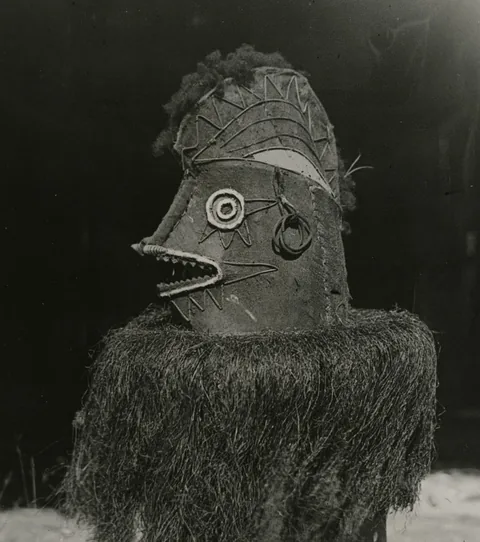 They Killed the Monster and Kept Its Voice
Source
Musée du quai Branly - Jacques Chirac, inv. 72.1965.7.18-19 (former collection F. W. Albrecht, collected 1927); Carl Strehlow, Die Aranda- und Loritja-Stämme in Zentral-Australien, part I (Frankfurt, 1907), Foreword and pp. 74, 101-102; Carl Strehlow, Die Aranda- und Loritja-Stämme in Zentral-Australien, part II (Frankfurt, 1908), Vorwort by M. von Leonhardi; Carl Strehlow, Die Aranda- und Loritja-Stämme in Zentral-Australien, part IV.1 (Frankfurt, 1913), pp. 12, 24-26, 31; Spencer & Gillen, The Native Tribes of Central Australia (1899), p. 246 n. 1 and pp. 248-249; A. Kenny, The Aranda's Pepa (ANU Press, 2013), Appendix B
Nearby in the atlas
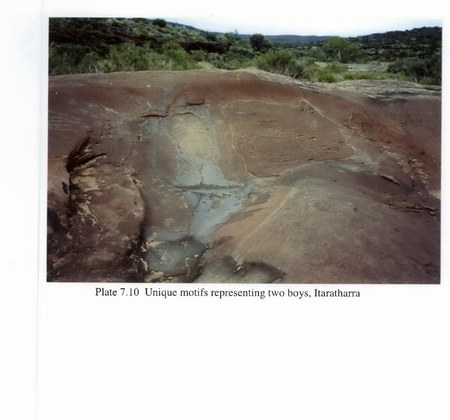 Etarratarra twin-boys bullroarersUndated · Australia · Sacred / spirit
 Arunta churinga bullroarer complexAustralia · MacDonnell Ranges / Alice Springs region · Restricted
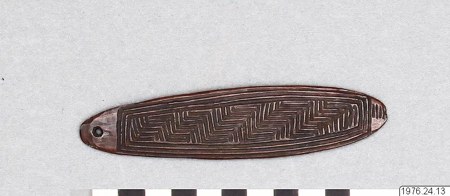 Kwerenaty, guardian of the initiatesAustralia · Upper Sandover River, north-east of the MacDonnell Ranges, Northern Territory · Restricted
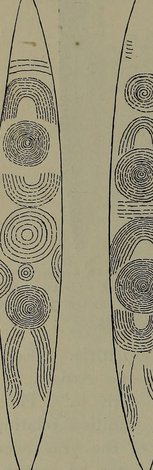 Kaitish (Kaytetye)Australia · Sandover / Barrow Creek region · Restricted
 Loritja apuju and mantiki bullroarersAustralia · Western MacDonnell / Hermannsburg-Finke region · Restricted
 Mularatara (Matuntara)Australia · Palmer River country, southern Western Desert · Restricted