No. MUS2026-346
Thirteen unprovenanced New Guinea blades
Papua New Guinea · Papuan Gulf (by style); locality unrecorded · Oceania
Function not recorded
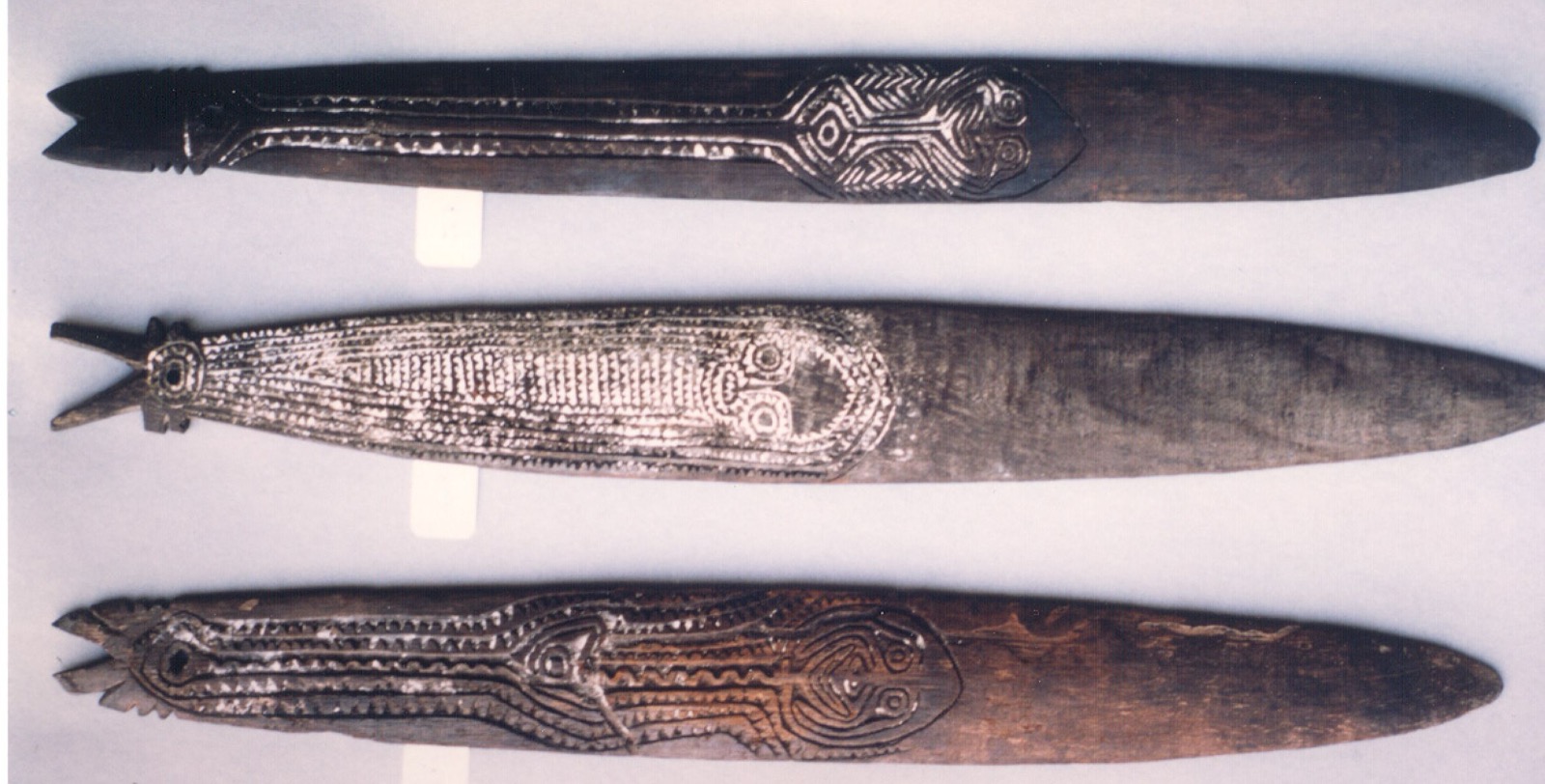


Source term: Rhombe
Eleven blades came out of New Guinea as one lot, engraved and painted in red, black and white, catalogued at sixty centimetres, no two silhouettes alike. The catalogue names no place, but the carving does: a long-bodied figure with ringed eyes cut down half the blade, the cord end notched like a mouth, as on the roarers of the Purari delta and the Gulf of Papua. They ended up in Issoudun, a market town in the middle of France, because the Missionaries of the Sacred Heart keep their mother house there: more than a thousand objects came back to it from their Pacific stations between the late nineteenth century and 1939, and this handful of roaring boards came back with them. Neuchâtel's ethnographic museum keeps two more, making thirteen.
Particulars
- Object
- Eleven engraved wooden blades collected as one lot, early twentieth century, painted red, black and white. Two more unprovenanced Papua New Guinea rhombi, 38 and 31.8 centimetres, are in the Musée d'ethnographie de Neuchâtel, V.826 and V.827: near-twins in length, nothing alike in outline, the larger still carrying its cord.
- Function
- Not recorded.
Source
Musée de l'Hospice Saint-Roch / MIMO, 2000.09.462.893 (lot of eleven)