No. MUS2026-325
Upper Watut bark-fibre bullroarer
Oceania -> Melanesia -> Papua New Guinea, East New Guinea Upper Watut River · Sahul
Restricted
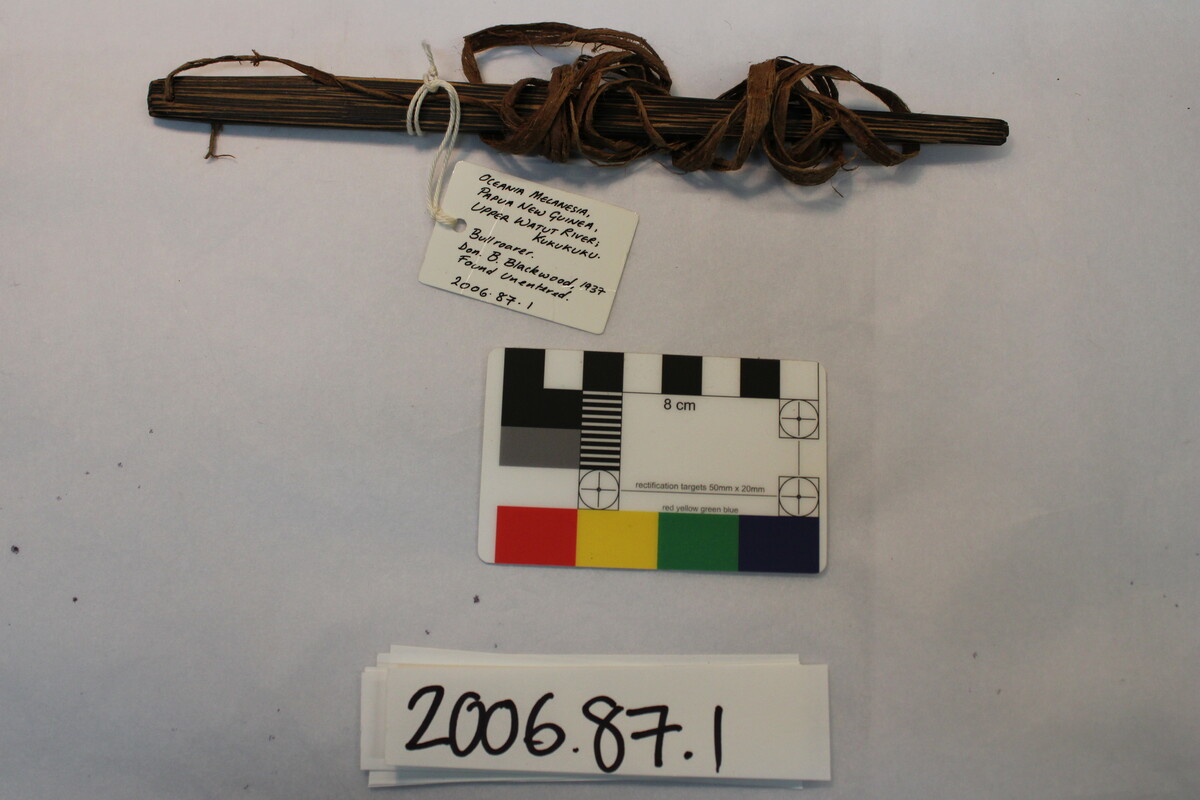
Source term: Bullroarer
Blade and cord usually part company long before a bullroarer reaches a museum shelf. This one never did: twenty-three centimetres of Anga wood from the Upper Watut, still rigged with the bark-fibre line that made it speak. The string is the cheap, perishable, replaceable half of the instrument and the half that almost never survives — and without it a bullroarer is only a shaped board. Beatrice Blackwood, who lived on the Upper Watut in 1936-37, wrote down what the string was for. In the Anga myth of the first men a man hears the bullroarer cry, goes and gets one and swings it; a woman comes close and he sends her away. The women do not know about the bullroarer; they must not see it, and if they do they will die; the men hide it in the bush, and it sounds in the bush. When that part of the story was told, the women sitting within earshot were sent away.
Particulars
- Object
- An Anga wooden bullroarer, 230 × 45 mm, still strung with its bark-fibre cord.
- Function
- Among the Anga of the Upper Watut the bullroarer was hidden in the bush and sounded there, and it was said that a woman who saw one would die.
Source
Pitt Rivers Museum 2006.87.1; An Anga wooden bullroarer, 230 × 45 mm, with its bark-fibre string; Beatrice Blackwood, The Kukukuku of the Upper Watut, ed. C. R. Hallpike (Pitt Rivers Museum, 1978), pp. 124 and 159