No. HAYS1986-011
Awa mahbi initiation roarer
Papua New Guinea · Mobuta River Awa · Eastern Family language region · Oceania · Sahul
Restricted
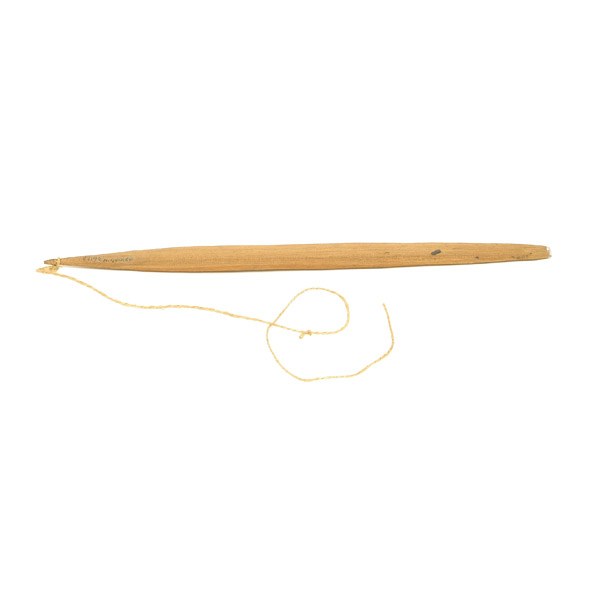
Source term: bullroarer
No Awa bullroarer term recorded by Hays.
An Awa boy became a new mahbi at thirteen to fifteen, after nose-bleeding, penis-cutting and cane-swallowing. Both sacred instruments belonged to that initiation — the paired transverse flutes and the bullroarer — and where both occurred, Hays found, both were revealed together, in ceremonies everywhere forbidden for women or children to watch. Of the Awa bullroarer itself nothing further is recorded: no local name, no dimensions, no story of its own.
in the regions where both instruments occurred both were revealed together at initiation, which everywhere was conducted in ceremonies which were forbidden for women or children to observe
Hays 1986:443 (Anthropos 81)
Particulars
- Object
- A bullroarer used alongside transverse flutes in Awa initiation; no size, form or local name is recorded.
- Function
- Recorded in initiation, sounding with the transverse flutes as a sacred men's instrument.
Source
Terence E. Hays, Sacred Flutes, Fertility, and Growth in the Papua New Guinea Highlands, Anthropos 81 (1986):435–453, at pp. 436, 443–44