No. STANNER1959-001Australia
Karwadi, from Serpent to All-Mother
Australia · Flora River · central Daly River, Northern Territory
Restricted
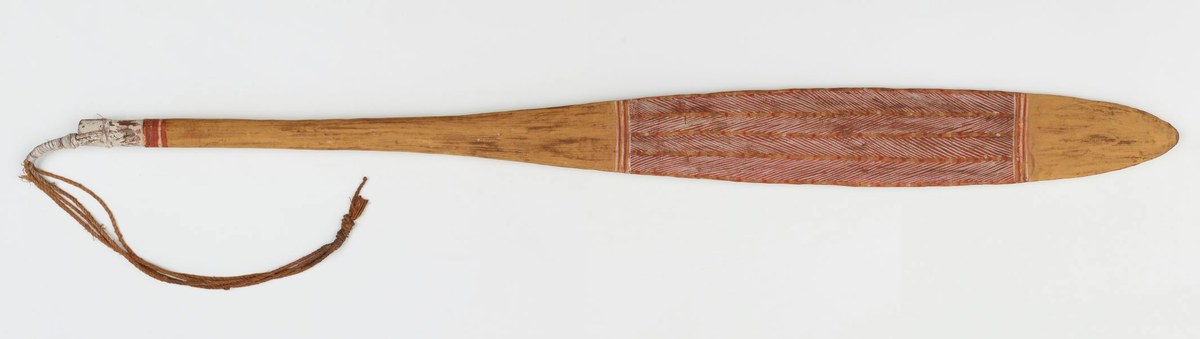
Karwadi
Source term: bullroarer / Karwadi
the Daly River name for the bullroarer and for the cult that took its name
In the 1920s the people of the Daly River became convinced that Angamunggi the All-Father — their form of the Rainbow Serpent — had deserted them. Barren women, spreading sickness, dwindling game: proof, people said, that he no longer looked after them; Stanner was told simply that Angamunggi had “gone away.” Into that vacancy came Kunabibi, the All-Mother, whose cult arrived, Stanner wrote, “at a beautifully appropriate time.” On the Daly it took the form of the cult of Karwadi — the name by which the bullroarer, symbol of the All-Mother, had been known even in the days of the All-Father. Young Nanggumiri men carried the rites home from Victoria River country. Durmugam was one of them: not the leader, in Stanner's judgement, but the secular force of the movement. The serpent never wholly let go: in the 1930s some Nanggumiri still said the bullroarer was his, not hers. By the 1950s young men mocked it. Warned that scorn could cost his life, one shrugged: "If I live, I live; if I die, I die." Then one of Durmugam's wives was "sexually abused, a traditional penalty, by a number of men", on the claim that she had seen a bullroarer in his camp. A lie, he said: every one was hidden in the bush. In 1978 Stanner returned to Peppimenarti with three bullroarers collected in the 1930s — one of them Durmugam’s own gift — so they could serve again in a Punj ceremony.
It was this [Karwadi] that the young Nangiomeri [Nanggumiri] brought back from the Victoria — a secret wisdom, a power, and a dream shared by no one else on the Daly River.
Stanner, 'Durmugam: A Nangiomeri' (1959), in White Man Got No Dreaming (1979), p. 84
Particulars
- Object
- The Karwadi bullroarer, symbol of the All-Mother.
- Function
- Karwadi, the name of the All-Mother's bullroarer, named the secret cult that young Nanggumiri men brought back from Victoria River country in the 1920s; in the 1930s some Nanggumiri still linked the bullroarer with the Rainbow Serpent rather than the All-Mother. A woman accused of seeing one could be sexually abused by a number of men, "a traditional penalty".
Source
W. E. H. Stanner, 'Durmugam: A Nangiomeri' (1959), in White Man Got No Dreaming: Essays 1938-1973 (Canberra: ANU Press, 1979), pp. 84, 90-92; W. E. H. Stanner, On Aboriginal Religion (1963; Sydney University Press, 2014 ed.), p. 60 and editors' introduction p. xxxiii