No. PNG96
Purari
Papua New Guinea · Gulf · Oceania · Sahul
Restricted
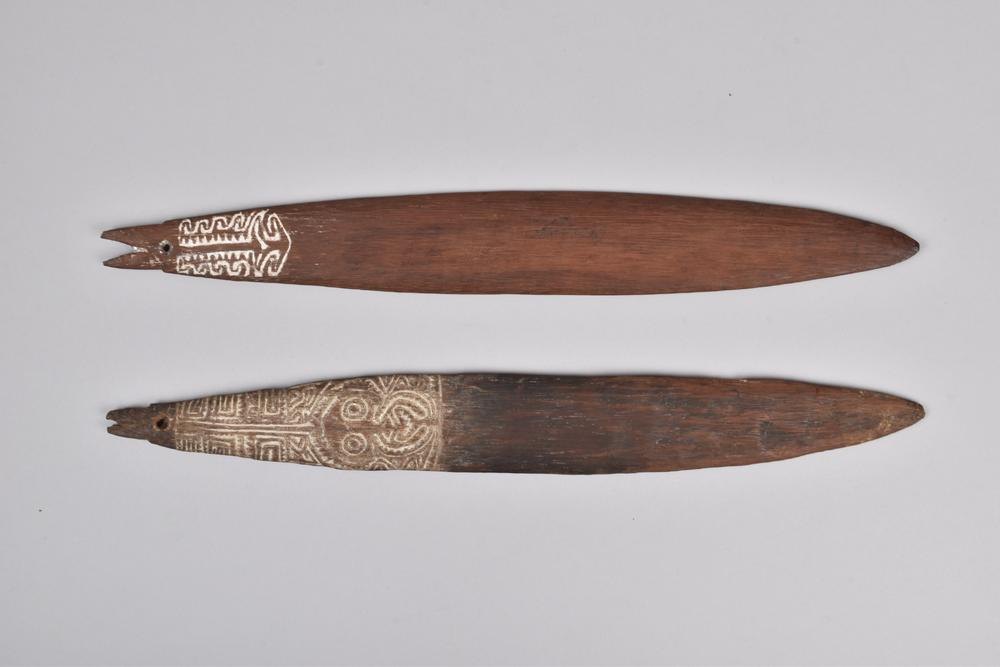
imunu viki
imunu viki = "weeping spirit" (Purari/Namau), the local name for the bullroarer; kaiemunu = the wickerwork monster of the ravi (men's ceremonial house) whose voice the bullroarer is.
Etymology. Imunu viki means "the weeping imunu," for its moaning voice as much as for its mourning of a dead amua. Its other name, kirore, was given it especially for its power to roar.
Every Purari man passed through Pairama, and its essential act was climbing into a kaiemunu — one of the hollow, wide-jawed wicker monsters kept in the rear of every ravi, the men's house. The roar of the bullroarer was said to be the kaiemunu's voice. The Koriki told how the two belonged together from the first: when Iri and Kai built the first kaiemunu as a house for themselves, they made bullroarers for its floorboards. The sacred blades, upura, lay hidden in the ravi and sounded at their own initiation and after the burial of an amua, a man of rank, when they became imunu viki, 'the weeping imunu,' mourning him. In the grade called upura ukua, the initiates were taught to make the blades themselves. On the Aivei side, daughters of amua could even own them. Household boards were another matter: Williams was almost scandalised to see a full-sized blade swung on a handle while women and children listened, amused. Farther east, Ipi elders told the missionary J. H. Holmes that women first found the roarer in the body of the slain god Oalea and whirled it, masked, at a feast, until the men saw through the disguise and seized it.
Sometimes called imunu viki (weeping spirit), bullroarers were also played at the funerals of prominent men where the sound represented the cries of a spirit (imunu) lamenting the person's death.
Metropolitan Museum of Art, New York, Namau bullroarer (imunu viki), 1979.206.1545
Particulars
- Object
- Hardwood upura boards, often carved with a face, concealed in the rear of the ravi; ordinary household boards formed a separate category. Three pointed Purari Delta blades, 77.5 to 88.9 cm long, their upper parts carved with human faces in white and black on a red ground, reached the Museum of Archaeology and Anthropology, Cambridge, from J. E. Foster in 1900 (E 1900.103); the one bearing that number has an incised, lime-filled face, a short ridge for the nose, and a nick at the string end where the cord was tied.
- Function
- Sacred spirit-voice boards at initiation and funerals; separate household boards sounded on coconut-grove patrols.
Source
F. E. Williams, The Natives of the Purari Delta, Territory of Papua Anthropology Report 5 (Port Moresby, 1924), pp. 131, 165–171; J. H. Holmes, In Primitive New Guinea (London, 1924), pp. 188–191; Gradhiva 14 (1991); Metropolitan Museum of Art, New York, 1979.206.1545; K. A. Gourlay, Sound-Producing Instruments in Traditional Society: A Study of Esoteric Instruments and Their Role in Male-Female Relations, New Guinea Research Bulletin 60 (Canberra, 1975), Table 1, entry 96; Museum of Archaeology and Anthropology, Cambridge, E 1900.103 (= Z 8293; AR 1900.1544-1546; Purari Delta; J. E. Foster); Joshua A. Bell, 'Out of the Mouths of Crocodiles' (2010), pp. 351-373