No. MUS2026-135
Milingimbi blade with human-hair cord
Australia · Milingimbi Island (Yurruwi), Crocodile Islands, Northern Territory · Arnhem Land
Restricted
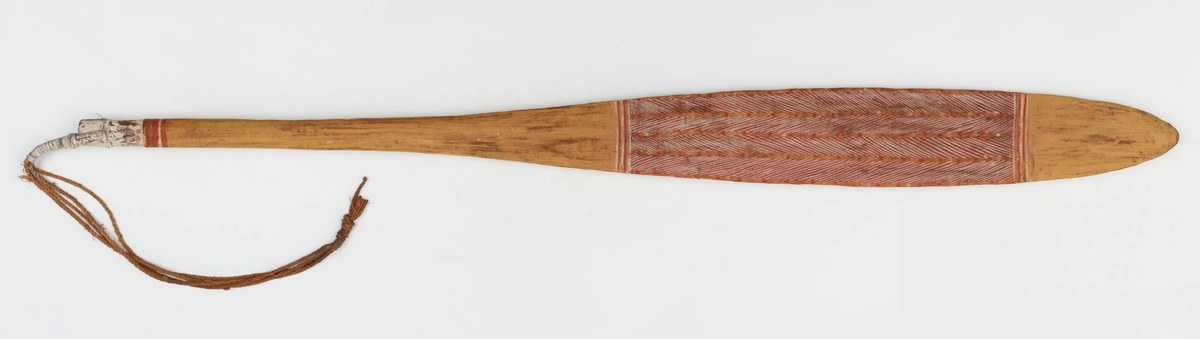
Source term: Bullroarer and cylindrical handle
At Milingimbi, the whole apparatus survives: an 86-centimetre leaf-shaped wooden blade, a cord of human hair, and the slim half-metre handle from which it was swung. Most museum bullroarers have lost their working tackle; this one still shows how blade, cord, hand, and air were joined. Milingimbi was one of the camps where Lloyd Warner gathered A Black Civilization, and in the rites he recorded there, bullroarers sounded the voice of the great ancestral python.
The bull roarer is attached to a human hair cord on a small stick before it is ready for whirling.
W. Lloyd Warner, A Black Civilization, rev. ed. (Harper Torchbooks, 1964), p. 281
Particulars
- Object
- Leaf-shaped wooden blade, 86 cm long and 8 cm wide, pierced at the rounded end for a human-hair cord about 10-12 ft long, and paired with a cylindrical wooden handle 52.1 cm long and 1.91 cm in diameter.
- Function
- At Milingimbi itself the roarer was the voice of the ancestral python in Yolngu men's initiation rites. No ceremony is recorded for this piece.
Sources
- Smithsonian National Museum of Natural History, Anthropology, object E387549-0 / nmnhanthropology_8421502 View
- W. Lloyd Warner, A Black Civilization (1937); revised edition (Harper Torchbooks, 1964), p. 281