No. PNG66
Orokaiva
Papua New Guinea · Northern · Oceania · Sahul
Restricted
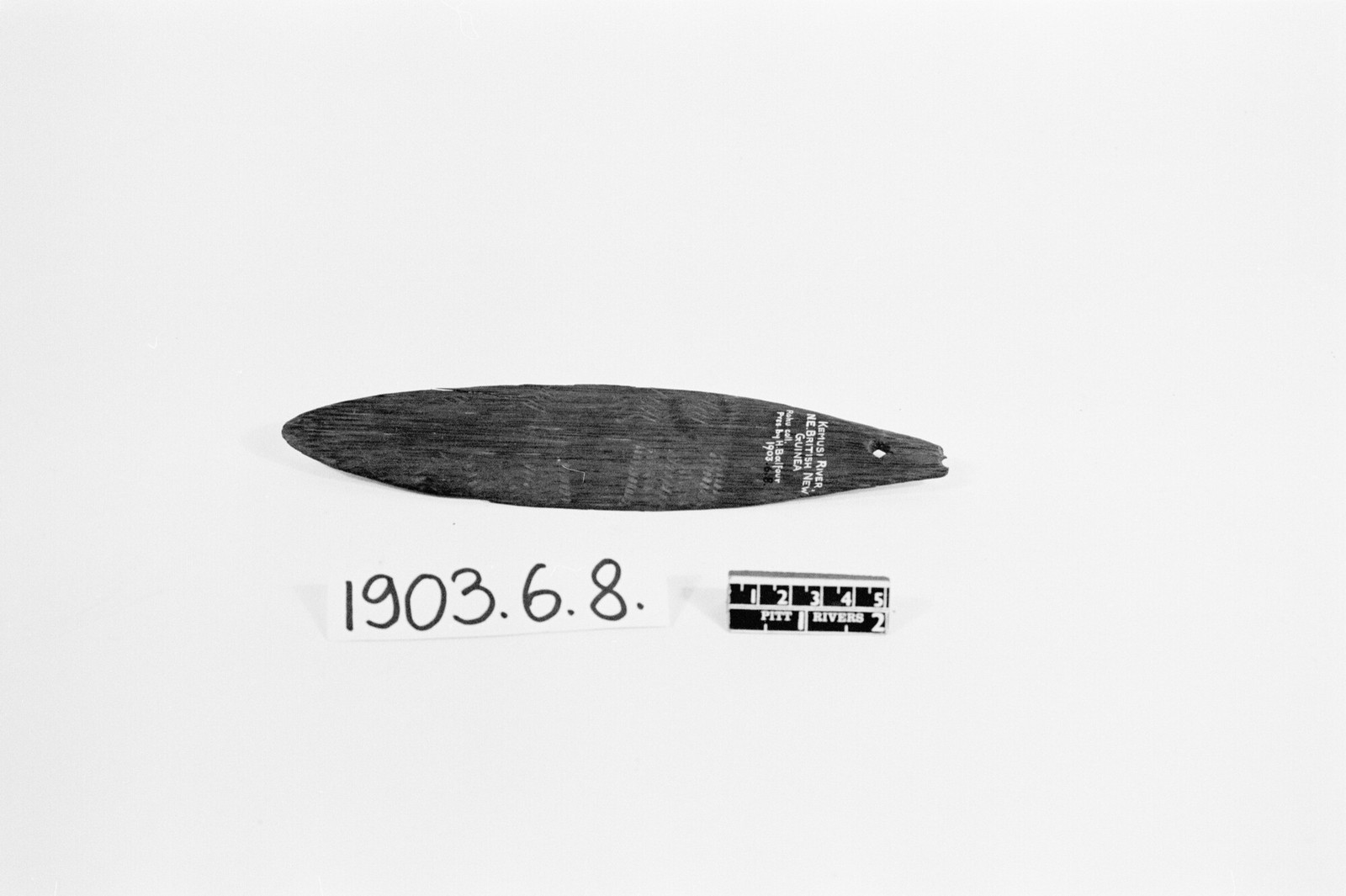
umbubu
umbubu: the bull-roarer of the southern Orokaiva, a thin slat of palm-wood swung during initiation.
Among the Orokaiva, initiation placed children among the ancestral dead. Masked men in bird feathers and pigs' tusks burst from the bush and carried the novices off to a forest seclusion house, closed in on all sides, where they were told they had become spirits: they must not wash, and their world narrowed to the windowless dark. There they learned the dances and the sacred instruments whose voices belonged to the beings they would one day embody. The bullroarer spoke for the embahi spirits.
There the initiates are taught to play the sacred flutes and bull roarers that are represented as the 'voices' of the spirits.
Bloch, Prey into Hunter (1992), p. 9, on Orokaiva initiation after Williams 1930
Particulars
- Object
- Blades swung on a cord from one end: one of wood, 23 cm long, incised along one face, from the Kumusi River; another of bark, carved with a human figure, from the Yodda Valley.
- Function
- Voice of the embahi spirits during Orokaiva initiation.
Source
K. A. Gourlay, Sound-Producing Instruments in Traditional Society: A Study of Esoteric Instruments and Their Role in Male-Female Relations, New Guinea Research Bulletin 60 (Canberra, 1975), Table 1, entry 66, and p. 70, after F. E. Williams, Orokaiva Society (1930), p. 195; Maurice Bloch, Prey into Hunter (Cambridge, 1992), p. 9; Pitt Rivers Museum, Oxford, 1903.6.8 and 1903.6.9