No. LOEB1929-002
Bunurong Victoria child-play bullroarer
Australia · Victoria · Southeast
Play / practical
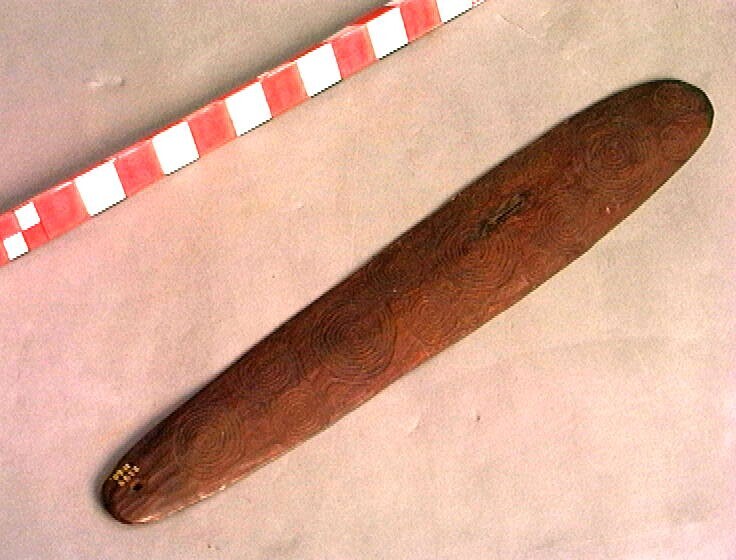
Source term: bullroarer
Across most of Aboriginal Australia the bullroarer was held sacred and kept hidden from women and the uninitiated, its roar taken for the voice of thunder or of a high god who presided over the men's initiation rites. Among the Bunurong of Victoria's coast it was none of these things. Edwin Loeb, drawing on Howitt, records that here the instrument was well known and served as a child's plaything, in a country where boys underwent no initiation beyond being released from their food restrictions.
Among the Bunurang tribe of Victoria, however, the bullroarer is well known and is used for a child's plaything. In this region there is no initiation other than the freeing of the boy from food taboos.
Loeb 1929, Tribal Initiations and Secret Societies, UCPAAE 25(3):250 (citing Howitt 1904:613)
Particulars
- Function
- A child's plaything among the Bunurong, though elsewhere regarded with reverential awe.