No. HAD1898-035
Dieri yuntha bullroarer
Central Australia
Restricted
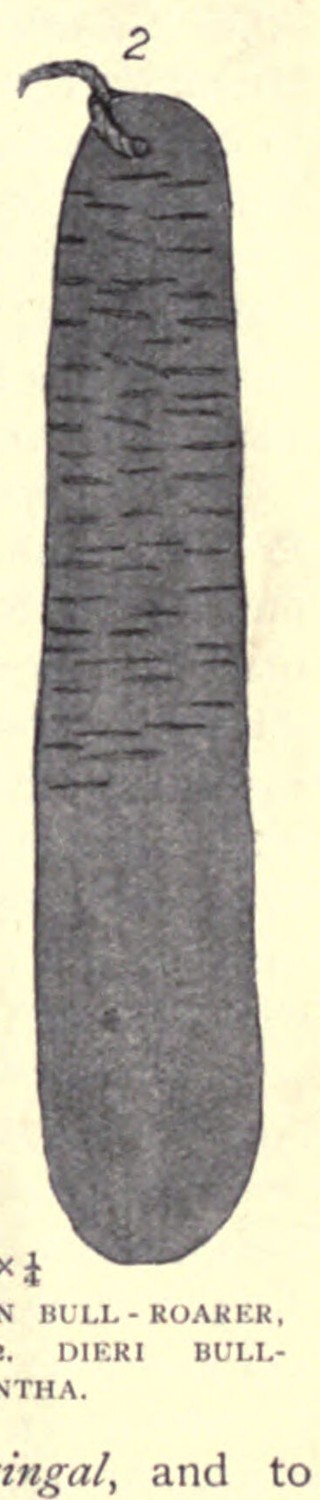
yuntha
yuntha — the Dieri bull-roarer, a hair- or flax-corded wooden blade given to a youth at the end of the Wilyaru initiation and whirled while hunting reptiles.
Among the Dieri of the Lake Eyre country in central Australia, a young man was handed his yuntha at the close of the Wilyaru ceremony, the rite that completed his initiation. He was told to whirl it around his head while out hunting: inspired by the Mura-mura of the ceremony, he was held to have the power to draw a good harvest of snakes and other reptiles into reach. The piece was a thin blade of wood, six to nine inches long, swung on a string of human hair or native flax ten to twelve feet in length. In the early 1870s the settler S. Gason was shown a yuntha only after promising never to let a woman see it or even learn that he had seen it.
The belief is that if a woman were to see a Yuntha which had been used at the ceremonies, and knew the secret of it, the Dieri tribe would ever afterwards be without snakes, lizards, and such other food.
Howitt, The Native Tribes of South-East Australia (1904), Chapter X (after Gason)
Particulars
- Function
- Secret bullroarer of the Wilyaru-initiated man, whirled while hunting to draw in snakes and reptiles.
Sources
- S. Gason, 'The Manners and Customs of the Dieyerie Tribe of Australian Aborigines,' in J. D. Woods (ed.), The Native Tribes of South Australia (Adelaide, 1879), pp. 253-307, via Howitt
- A. W. Howitt, The Native Tribes of South-East Australia (1904), ch. X, after Gason View · archived
- A. C. Haddon, The Study of Man (1898), p. 315
- A. W. Howitt, 'The Dieri and Other Kindred Tribes of Central Australia,' Journal of the Anthropological Institute 20 (1890), p. 83, cited in Haddon (1898)