No. AUSMAIN-020
Sunday Island bullroarer (Mjöberg expedition)
Western Australia · Kimberley · Sunday Islands
Sacred / spirit
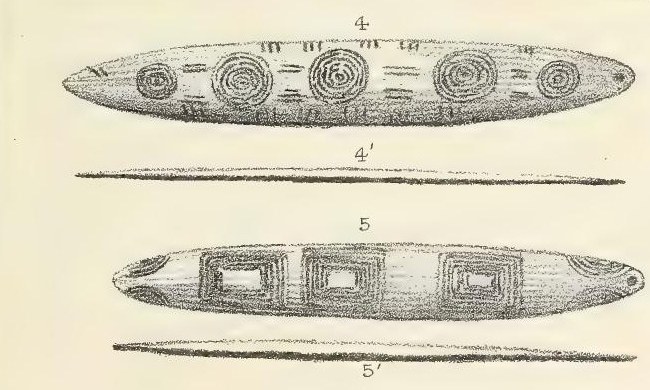
Source term: vinare / bullroarer
Its whirr was the voice of Djamar, the hero who rose from the sea whirling a bullroarer and struck south. He split boards from a silver-blood tree and drove them into a creek bed as a line of sacred galaguru; on Burumar sandhill his hair-string snapped and the board shot skyward, lodging in the Coalsack near the Southern Cross, the realm of the dead. On these islands at the mouth of King Sound, Bardi and Jawi initiates were led to that creek and shown the holes where the god had planted his bullroarers in stone.
Particulars
- Object
- Three painted wooden bullroarers, SMVK 1912.01.1021-.1023, with transverse red, yellow, dark, or grey bands: .1021 and .1022 are from Sunday Islands, .1023 from Mt. Barnett in the Kimberley. The first is marked ceremonial and .1022 secret/sacred.
- Function
- A Bardi and Jawi initiation bullroarer, the galaguru of the creator-hero Djamar.
Source
Etnografiska museet, Stockholm, 1912.01.1021 (Carlotta object 1635147); SMVK general catalogue, p. 245, accessions 1912.01.1021-.1023