MUS2026-369 - museum specimen
Whirler still tied to its stick
Australia - Western Queensland
Function not recorded
Source term: Bull-Roarer; "whirler"
whirler: the colonial Queensland name for the bullroarer, Roth's "whirler, whirring-stick, roarer".
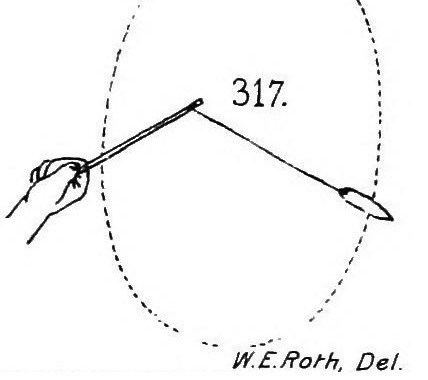
In north-west-central Queensland in the 1890s, Walter Roth described how a whirler was made: a spindle of gidyea bored at one end with a sharpened emu bone, tied to a string that was fixed to the end of a small stick. With the stick in the hand, the board could be spun until the air caught its flat face and roared. This western Queensland whirler has come down whole, stick and all, on a cord twisted from human hair and plant fibre. Roth found two kinds in that country: small plain boards that anyone could play with, and larger engraved ones that sounded at initiation and were kept from the sight of women.
this whirler is attached to a piece of string fixed to the end of a small stick; with the latter held in the hand the "roarer" can be made to rapidly revolve, the flat surface as it catches the wind, giving rise to the noise
Walter E. Roth, Ethnological Studies among the North-West-Central Queensland Aborigines (1897), p. 129, sect. 215
- Object
- Complete wooden bullroarer, catalogued at 54 x 6 cm, tied by a cord of human hair and plant fibre to a light stick handle.
- Function
- Not recorded.
- Source
- Penn Museum P4728, formerly Australian Museum E4215; Western Queensland; wood, hair, plant fibre; "Bullroarer or 'whirler,' complete with string and handle; Small, attached by cord of human hair and vegetable fibres to light stick." Exchange with the Australian Museum, 1913. Regional context: W. E. Roth, Ethnological Studies among the North-West-Central…
- Source location
Page references
P4728 (old no. E4215)
- Source confidence
- low
- Location note
- Deliberately broad Western Queensland anchor; the museum records no finer locality or people.