No. PNG138
Kamano, Fore, Jate, Usurufa
Papua New Guinea · Eastern Highlands · Oceania · Sahul
Restricted
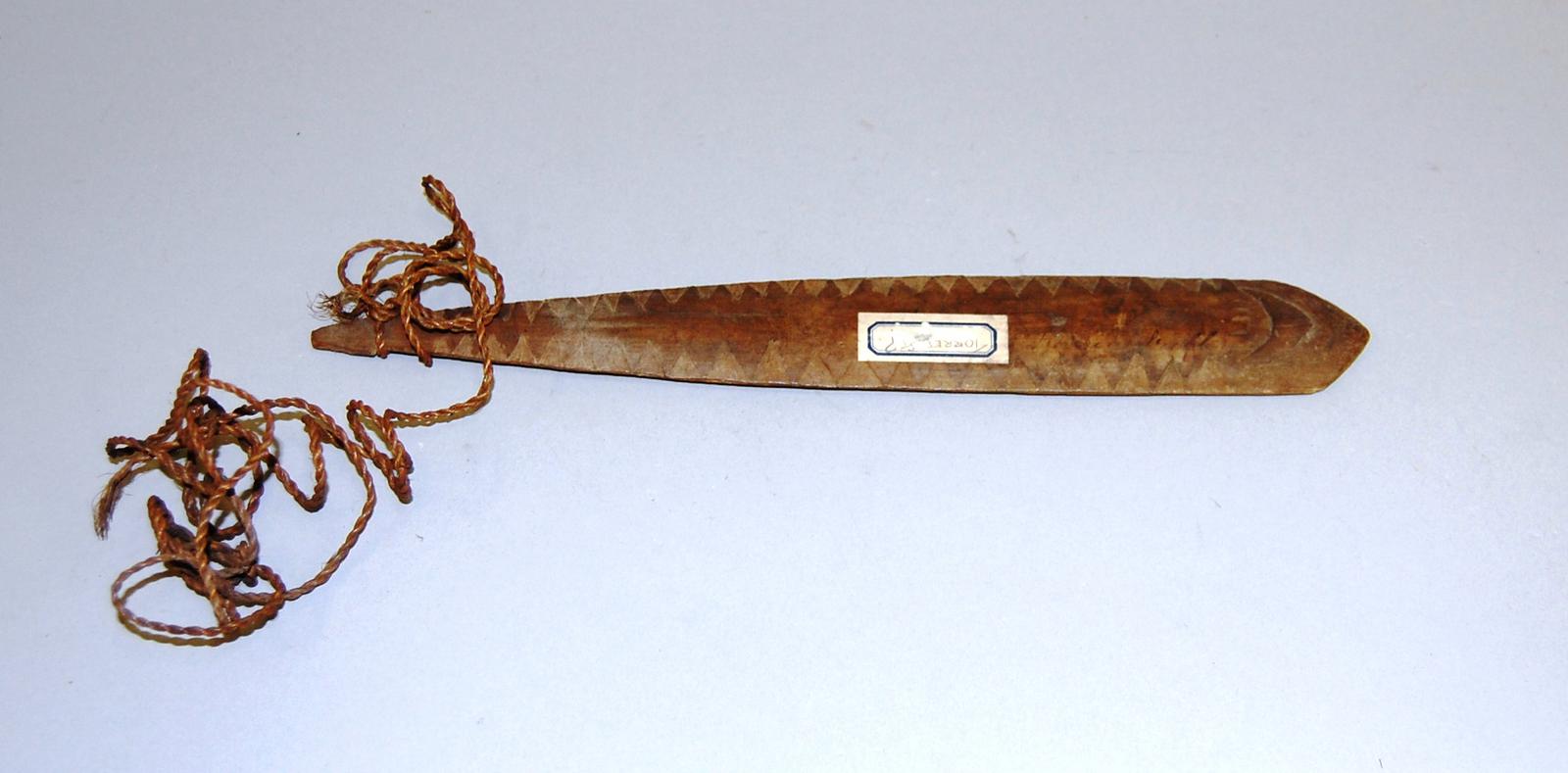
obubugariye / pubunanune
obubugariye (South Fore) / pubunanune (North Fore): 'humming sound; bull-roarer that makes a humming sound' — a single Fore word for both the instrument and its droning noise (Fore, Kainantu–Goroka family; the south-easternmost of these Highlands peoples). Graham Scott, Fore Dictionary (Pacific Linguistics C-62, 1980).
Etymology. Among the Fore of the Eastern Highlands, the bullroarer bears the same word as the humming noise it makes, in the southern dialect (obubugariye) and the northern (pubunanune) alike: the instrument is named for its own droning voice.
The men's cult of the Kamano, Usurufa, Jate and Fore guarded bamboo flutes and bullroarers from women and children; a woman who saw them faced severe punishment. Yet their myths gave the flutes first to Jugumishanta, the earth-mother, who with her husband Morufonu was reckoned a parent of all things. Morufonu stole them; then he made a bullroarer to frighten her, reversing their first encounter. Among the southern Kamano, Usurufa and Jate, fathers told boys the roarer was guᶜnagu gosunamu, a blue water-spirit with no belly and a huge mouth, who swallowed boys until their fathers threw ripe bananas into the water to buy their release. At the bush shelter, flutes played while a bullroarer swung behind it, and the novices' noses were bled. The roarers sounded again as the Kamano and their neighbours made ready for the pig festival, the end of moon after moon of flute-playing that made the pigs grow and the crops advance.
Particulars
- Function
- Sounded at nose-bleeding initiation and in preparations for the pig festival; among the southern Kamano, Usurufa and Jate, the voice of a swallowing water-spirit.
Source
Ronald M. Berndt, Excess and Restraint (Chicago, 1962), pp. 51, 54, 62, 94–95; K. A. Gourlay, Sound-Producing Instruments in Traditional Society, New Guinea Research Bulletin 60 (Canberra, 1975), Table 1, entry 138, and pp. 45–46, 55; Graham Scott, Fore Dictionary, Pacific Linguistics C-62 (Canberra, 1980)