No. NGUINEA-009
Orokaiva bullroarer, Kokoda District
Papua New Guinea · British New Guinea · North Division · Kokoda District · Oceania · Sahul
Restricted
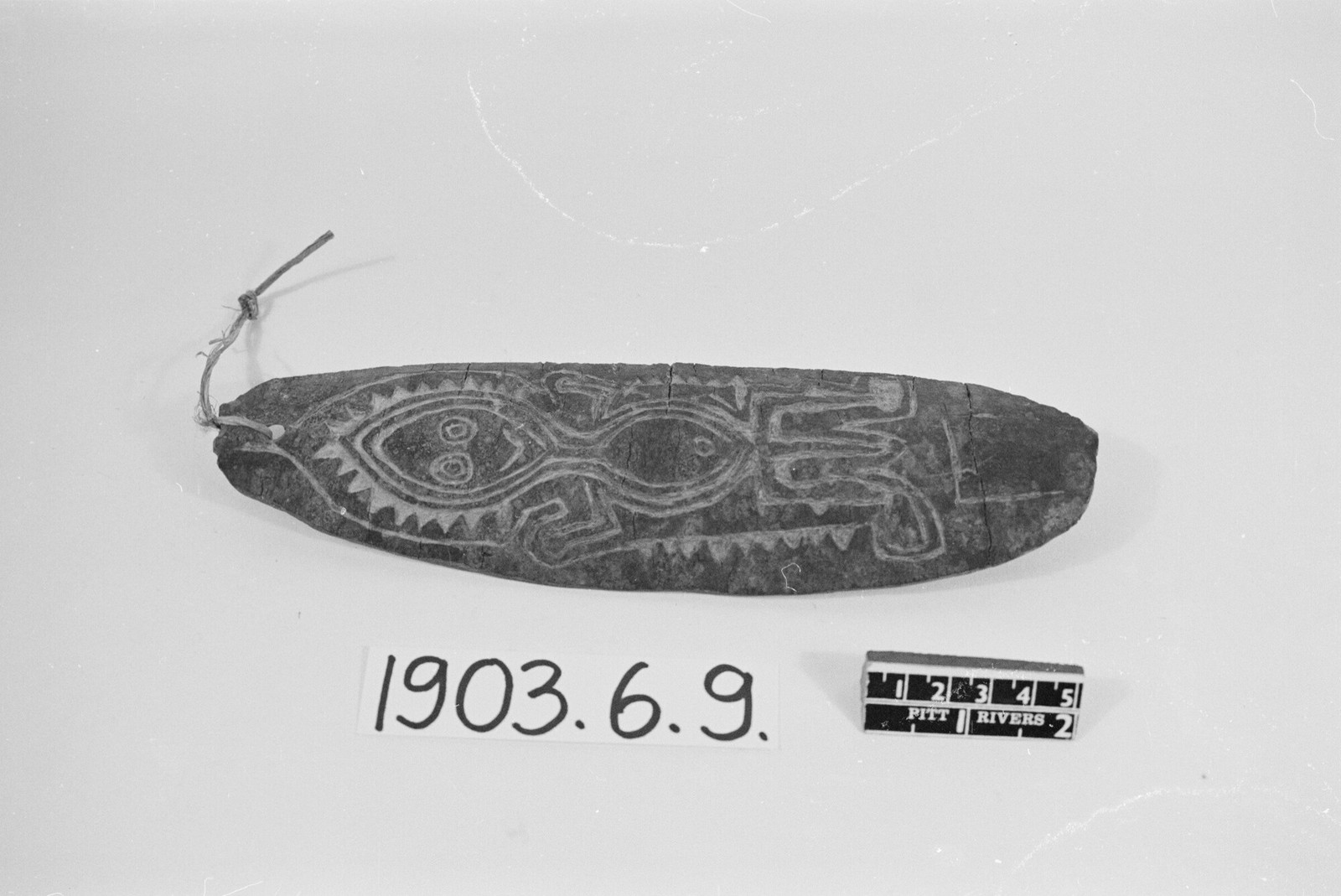
Source term: Bullroarer
A small bullroarer of striped wood, carved at each end, with a cane string through a hole at one end, collected among the Orokaiva of the Kokoda District in the North Division of British New Guinea. It was gathered and given to the Cambridge Museum of Archaeology and Anthropology by Evelyn Cheesman, the English entomologist who made eight solo expeditions through the southwest Pacific between 1924 and 1952. The catalog card preserves the warning that came with it: the object must never be seen by women or girls, nor knocked, or the man who gave it up would fall ill with yaws. No rite was written down, but that prohibition was, fixing the object as something dangerous to mishandle.
[This] must never be seen by women or girls, or knocked, otherwise in the latter case the original donor will suffer from yaws.
Cambridge MAA, object 1934.1059 (catalog note)
Particulars
- Object
- Cambridge MAA 1934.1059, bullroarer from British New Guinea, North Division, Kokoda District.
- Function
- Not recorded.
Source
Cambridge MAA 1934.1059, bullroarer; place Melanesia, Papua New Guinea, British New Guinea, North Division, Kokoda District