No. LANG1884-003
Chepara bribbun death-taboo bullroarer
Australia · New South Wales border coast · Southeast Queensland
Restricted
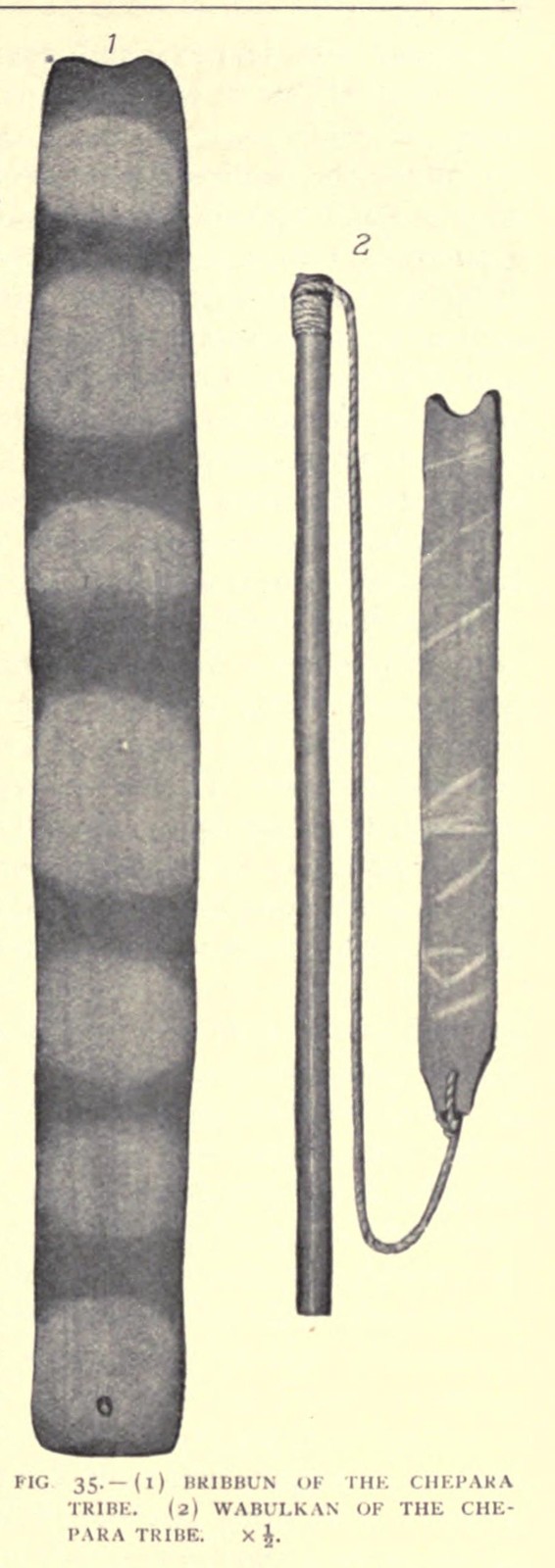
bribbun
Source term: bribbun / bull-roarer
bribbun — the Chepara name for the bull-roarer, distinguished from the smaller wabulkan given to newly initiated novices.
Among the Chepara of the southern Queensland coast, the bribbun was the bull-roarer that the headman kept hidden until an initiation was called, then placed in the hands of the messenger who went the whole round of the tribe summoning the clans, carrying it alongside the marked message-stick. Women and children were never to see it, and for a woman who did the penalty was death. The instrument was held to possess a mysterious and secret power. At the close of the ceremonies the man who had charge of it showed it to the boys for the first time and gave each a smaller one, called wabulkan, a warrant that they had been initiated and a vessel of the same power in lesser degree, which its owner then kept carefully concealed. Andrew Lang had already seized on the Chepara death-rule in his 1884 essay on the bull-roarer, reading the Australian instrument against the spinning toy of English schoolboys and the rhombos of the Greek mysteries.
Women and children are not permitted to see it, and if seen by a woman, or if shown to one by a man, the penalty is death, in the latter case to both.
Howitt 1904, The Native Tribes of South-East Australia, p. 578
Particulars
- Function
- Restricted bullroarer with explicit women-taboo death sanction.
Sources
- A. W. Howitt, The Native Tribes of South-East Australia (1904), pp. 578-579 View
- Andrew Lang (1884), p. 34, earlier account in the Fison–Howitt source chain