No. MUS2026-073
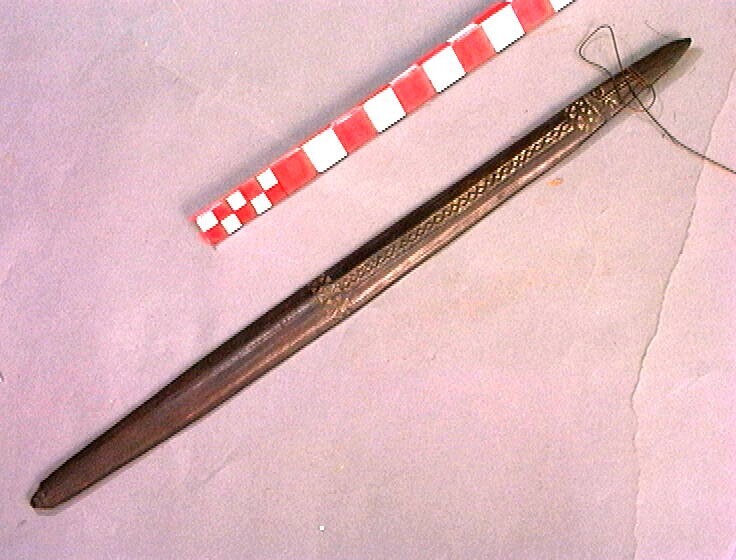
Bongu blade pointed at both ends
Papua New Guinea · Rai Coast, Madang (Astrolabe B · Oceania · Sahul
Restricted
Source term: bull-roarer
'Pronkpijl of bromhout' (Dutch) = 'show-arrow or bullroarer'. 'Schwirrholz' (German) = bullroarer.
From Bongu comes an ornamented wooden bullroarer whose flat, leaf-shaped blade tapers to a point at either end. Geometric carving covers its face, and the swing-cord still passes through one tip: decoration and working tackle survive together. What such a blade was for on this coast, Schmeltz set down in 1896 from the men who had been there. Finsch, who got them only at Friedrich-Wilhelmshafen, where they were called tonde, found them at Bilia carefully wrapped in tapa and kept in the assembly house; the people regarded them with a taboo-like awe and let no one touch them. Schellong's account of the circumcision festival showed what the wrapped spatulas were: bullroarers, which served to keep the women away from the ceremonial ground and had to be hidden from their eyes — ssălilūm, in the bush.
… glaubte sie als Brecher für Betelnüsse ansprechen zu müssen. Es scheint mir aber richtiger, sie unter die Kalkspatel zu stellen, wenn ich darüber auch keine positive Gewissheit erhielt.
… thought I had to take them for betel-nut crackers. But it seems more correct to me to class them with the lime spatulas, even if I got no positive certainty about it.
Otto Finsch, Ethnologische Erfahrungen und Belegstücke aus der Südsee (Vienna, 1891), p. 65, quoted in J. D. E. Schmeltz, "Das Schwirrholz. Versuch einer Monographie", Verhandlungen des Vereins für naturwissenschaftliche Unterhaltung zu Hamburg IX (1896), p. 104
Particulars
- Object
- Ornamented flat wooden blade, leaf-shaped and pointed at both ends, with geometric carving and its swing-cord through one tip; Wereldmuseum RV-1351-17.
- Function
- On the Astrolabe Bay coast the tonde was kept wrapped in tapa in the men's assembly house, held in taboo-like awe and let to no one's hand; at the circumcision festival the roarers kept the women away from the ceremonies and had to stay hidden from their eyes, in the bush.
Sources
- Wereldmuseum (NMVW), object RV-1351-17 (Bongu, Astrolabe Bay) View
- J. D. E. Schmeltz, “Das Schwirrholz: Versuch einer Monographie,” Verhandlungen des Vereins für naturwissenschaftliche Unterhaltung zu Hamburg 9 (1896), pp. 104-106 View · archived
- Otto Finsch, Ethnologische Erfahrungen und Belegstücke aus der Südsee (Vienna, 1891), p. 65, via Schmeltz 1896, p. 104
- K. A. Gourlay, Sound-Producing Instruments in Traditional Society: A Study of Esoteric Instruments and Their Role in Male-Female Relations, New Guinea Research Bulletin 60 (1975), Table 1, entry 38