No. AUSIN-017
Yolngu python paddle, Yurlunggur's voice
Australia · Arnhem Land
Restricted
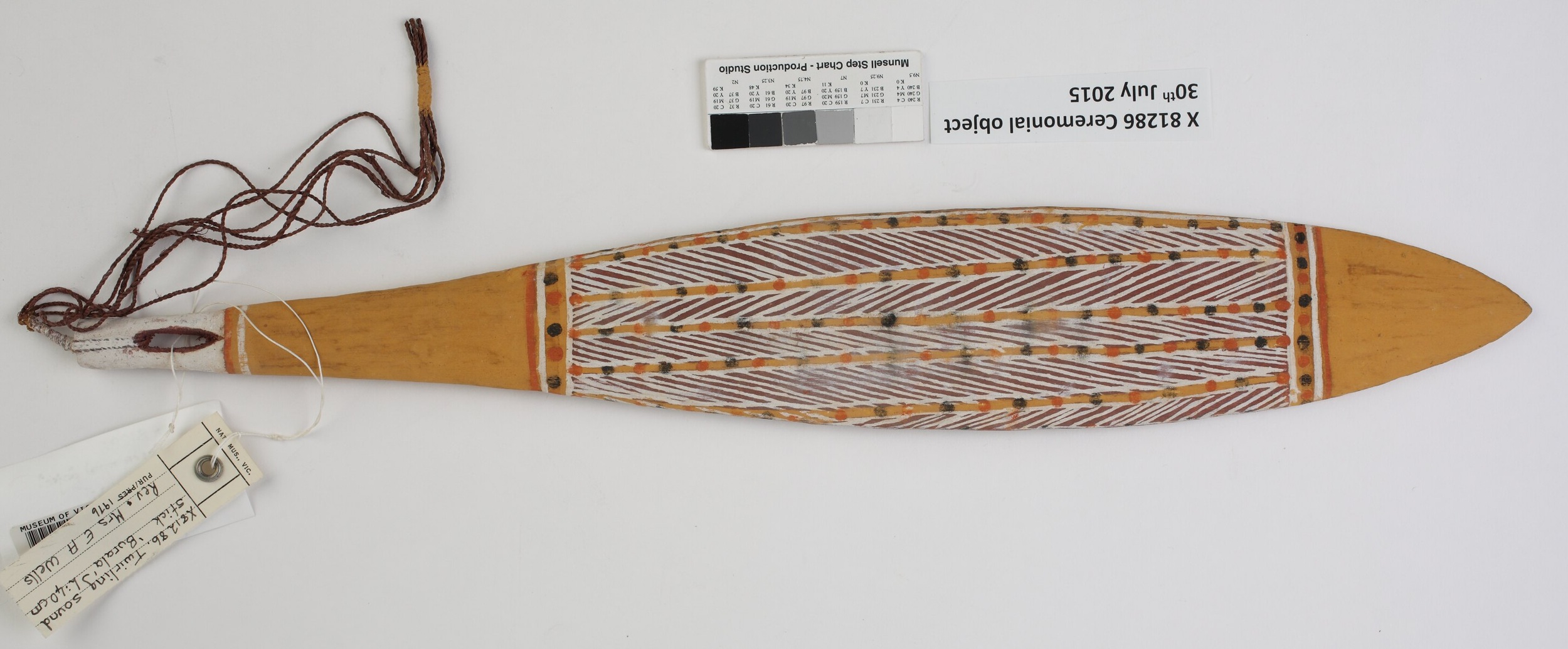
Source term: bull roarer
This python-painted paddle is not a picture of the great snake Yurlunggur — swung hard on its cord, it is his voice. The men of Arnhem Land told the women that the whirring roar was the serpent crying out in hunger, and that any woman who came near would be swallowed whole. At initiation the men themselves become Yurlunggur: they sweep the boys up, "swallow" them into ground no woman may enter, and weeks later hand them back, regurgitated as grown men. W. Lloyd Warner recorded the rite among the Yolngu in 1937.
Particulars
- Object
- A tapered paddle with a painted python design and braided hair.
- Function
- The voice of the python Yurlunggur: at Yolngu initiation men "swallow" the boys into forbidden ground and return them weeks later as men, while women are told the roar is the hungry serpent itself.
Source
Peabody Museum of Archaeology and Ethnology, Harvard University, 30-54-70/D3412.1, 'Bull roarer, python design' (Yolngu, Northern Territory); W. Lloyd Warner, A Black Civilization: A Social Study of an Australian Tribe (New York: Harper, 1937); Ronald M. Berndt, Kunapipi: A Study of an Australian Aboriginal Religious Cult (Melbourne: Cheshire, 1951)