No. MUS2026-390Oceania
Walembale, roarer of its own rite
Papua New Guinea · Kwanimbandu, Wosera, south of Maprik, East Sepik Province · Oceania
Sacred / spirit
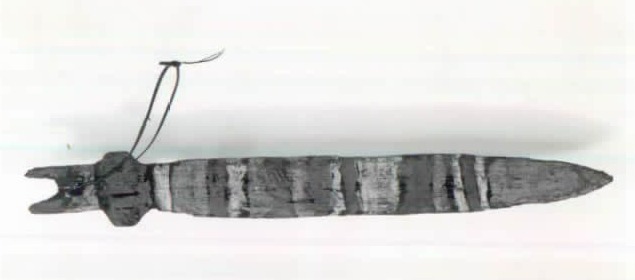
walembale
Source term: Walembale Schwirrholz; "walembale bullroarer"
walembale - the bullroarer and the ceremony in which it was used (Forge).
Walembale was the name of the bullroarer and of the ceremony it sounded in. Anthony Forge bought it during his first fieldwork among the Abelam, in 1958 and 1959, at Kwanimbandu in the Wosera, the country of the southern Abelam south of Maprik. The blade is painted in bands of red, yellow and white, and its head is cut into a collar and two short prongs, like ears, with the cord tied through below them.
Walembale bullroarer, used in ceremonies of the same name.
Anthony Forge, field note on the Museum der Kulturen Basel inventory card for Vb 16535
Particulars
- Object
- A 41 cm wooden blade painted in bands of red, yellow and white, with a waisted, pierced head ending in two short prongs (MKB Vb 16535).
- Function
- Sounded in the ceremonies called walembale, after the instrument.