No. MAT1898-012
Macleay Bellinger gheewarra ngaranya yeemboomul
Australia · Macleay and Bellinger Rivers · Southeast
Restricted
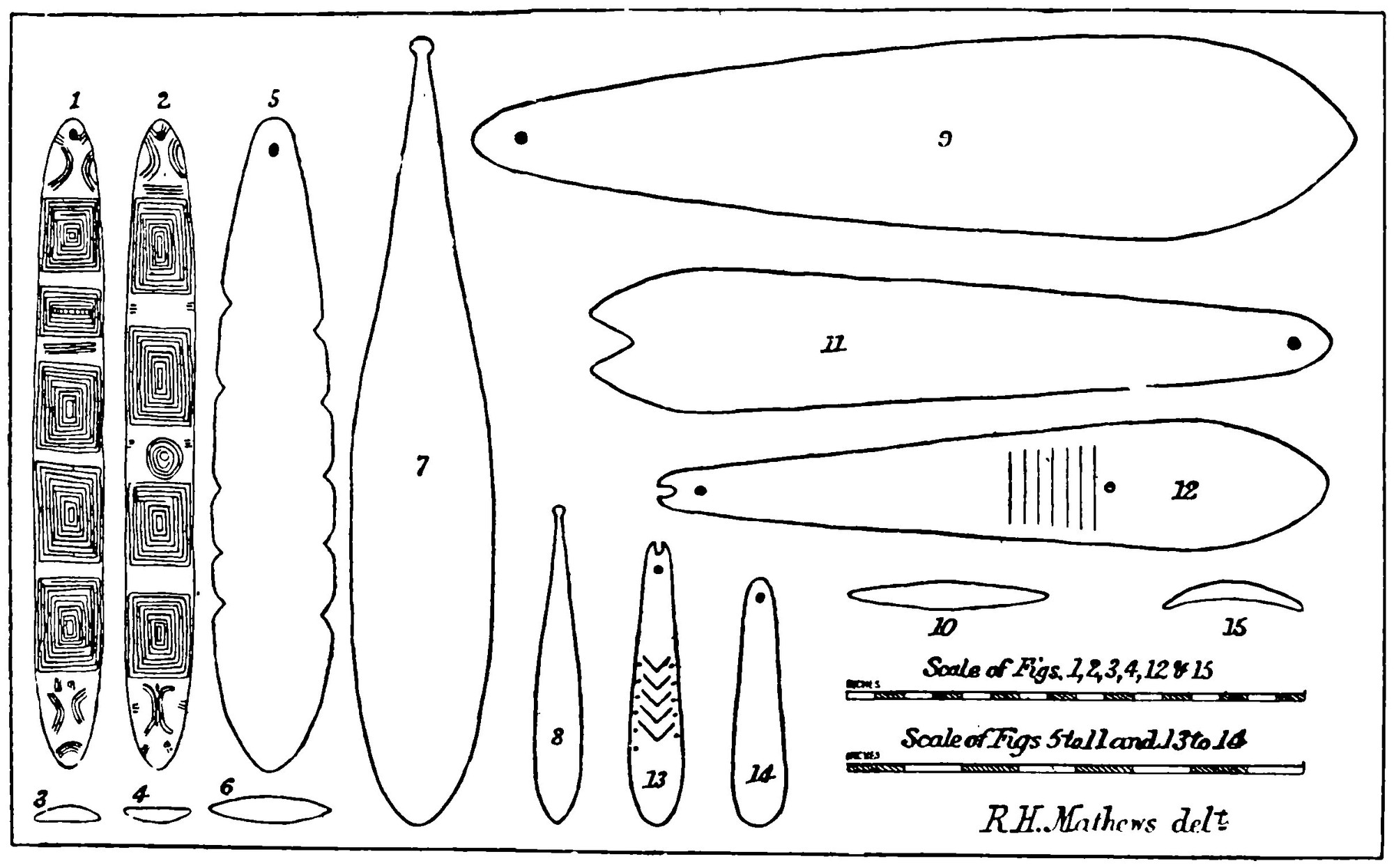
gheewarra / ngaranya / yeemboomul
Source term: bull-roarer
gheewarra (also ngaranya): the small bull-roarer of the Macleay and Bellinger River tribes; yeemboomul, their larger instrument.
Miles from the main camp, initiated men cleared a secret twenty-foot ring in the bush and whirled the gheewarra there — a short blade of wood on a cord — chanting as its hum rolled back to summon the rest. Novices were hoisted overhead, buried under leaves for a night, and menaced with spears. This was the Murrawin of the Dunghutti and Gumbaynggirr, along the Macleay and Bellinger Rivers of New South Wales, and the roarer's voice was kept from every woman and child. A larger instrument, the yeemboomul, sounded beside it.
This drawing shows the gheewarra or ngaranya, the small bull-roarer used at the initiation ceremonies of the tribes occupying the Macleay and Bellinger Rivers, on the north-east coast of New South Wales. The length is 4⅛ inches, the breadth 15/16 of an inch, and its thickness ⅛ of an inch.
Mathews 1898, "Bull-roarers used by the Australian Aborigines," JAI 27, Fig. 14
Particulars
- Function
- Small gheewarra/ngaranya bullroarer used at initiation ceremonies; larger yeemboomul also used by the same tribes.
Source
Mathews 1898, Bullroarers used by the Australian Aborigines, Journal of the Anthropological Institute 27:52-60