No. HEUVEL2025-001
Kamenwon before the Kao flood
Indonesia · Waniktit (Winiktit), on the Wanik tributary of the upper Kao River, Boven Digoel, South Papua · historic Netherlands New Guinea · Oceania · Sahul
Function not recorded
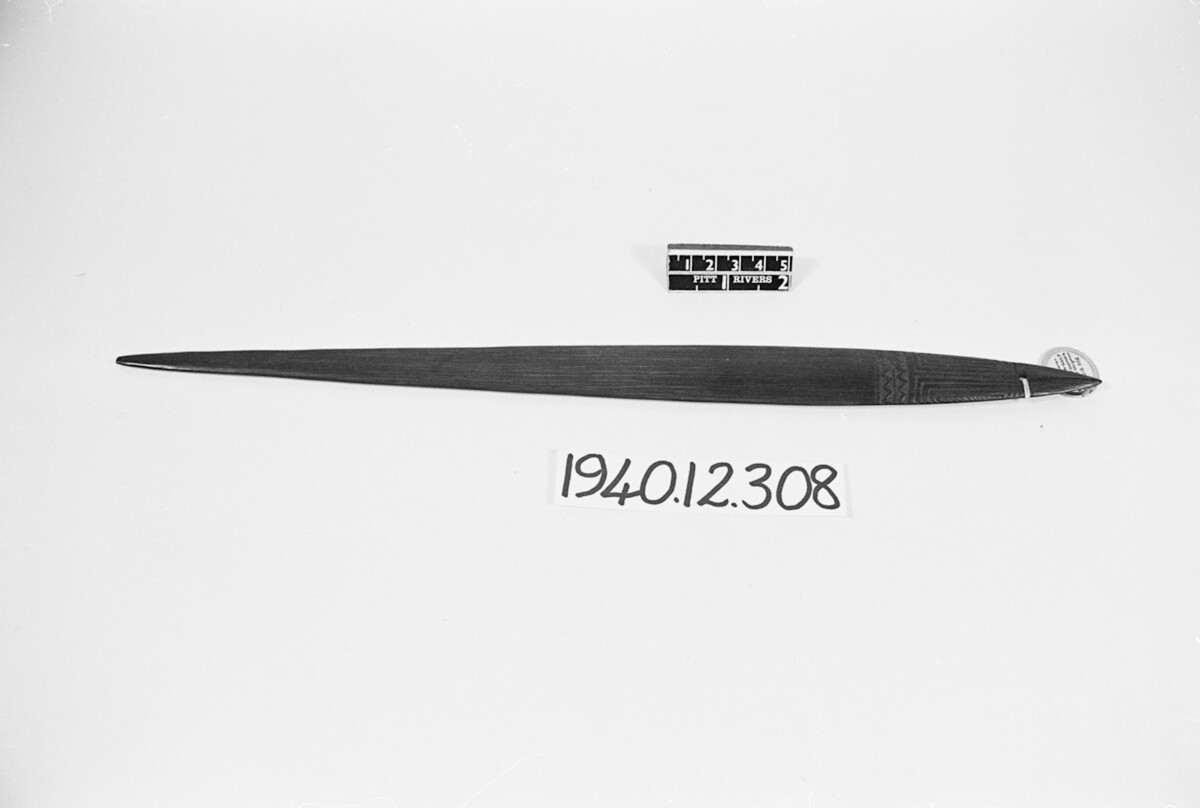
kamenwon
Source term: bullroarer (Drabbe: bromhout)
kamenwon: bullroarer (Drabbe 1956: kamenwon in, "to swing the bullroarer"). segepotop: a kind of palm. Ogip, Kawokawonjop: sacred names of the Kao River.
A man set out swinging a kamenwon, the bullroarer, then thrust it into a segepotop palm and walked downstream to an island at the mouth of the Kao. So opens the Yonggom Wambon story of how their river began. Water kept welling up out of the ground. People felled mbenggetkom trees and dammed it, and the water rose and filled with fish, which snapped the sago-midrib arrows shot at them and fled upstream. A catfish came, and the people sharpened a spear of damar wood. Then from upstream the flood came down carrying everything: pigs, sago palms, dogs, men and women. They gave the river its sacred names, Ogip and Kawokawonjop; people now call it the Kao. Men and women swam to the Wambon country, two men and two women swam together to the Muyu, and the dog Anonggejop came up out of the water at the mouth of the Kowet and became a rat.
A certain person went out hurling a bullroarer; he went and stuck it into a segepotop palm.
Drabbe 1959, Text 1.01, in van den Heuvel, Yonggom Wambon (2025), p. 285
Particulars
- Object
- A bullroarer called kamenwon, swung on its cord; no specimen or description recorded.
- Function
- Not recorded. In the origin story of the Kao River, a man sets out swinging a kamenwon and plants it in a segepotop palm.
Sources
- Wilco van den Heuvel, Yonggom Wambon, a Dumut Language of West Papua: Annotated Texts with Grammar and Vocabulary (ANU Press, 2025), pp. 256, 285–292 View
- P. Drabbe, Kaẹti en Wambon: twee Awju-dialecten (1959), Text 1, via van den Heuvel 2025