LINDSEY2019-001 - ethnographic attestation
Waglla, voice of the first words
Papua New Guinea - Bituri River, South Fly District, Western Province (Pahoturi River language area; Ende villages Limol, Malam and Kinkin) - Oceania - Sahul
Sacred / spirit
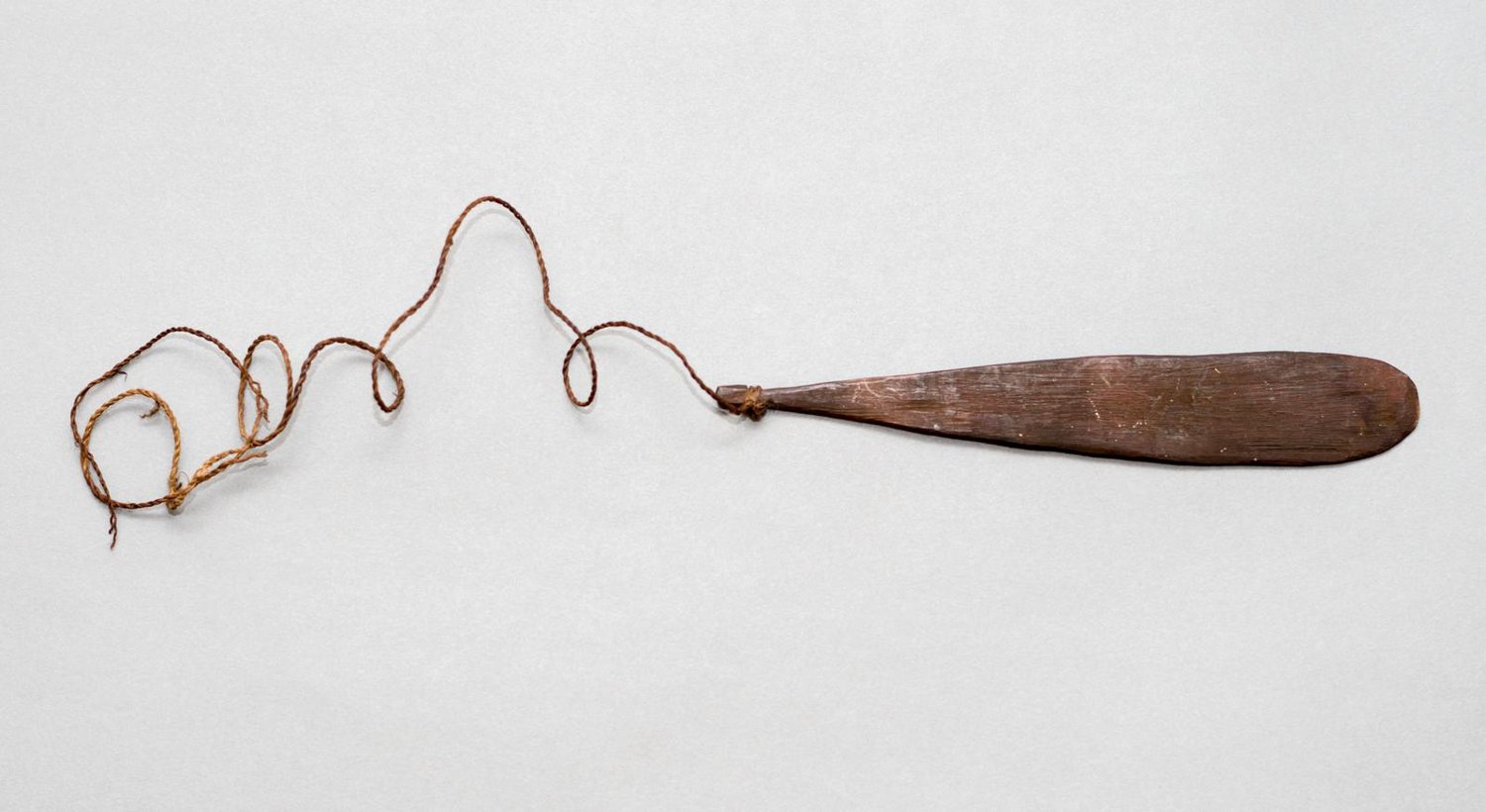
waglla
Source term: bullroarer
waglla /waɡɽa/: the Ende bullroarer. tawe: the palm whose bark it is cut from; gogo (green) and pall (red) are the twin tawe palms of the origin story. Ende: "what?" — the language is named for the word, as its neighbour Agob is.
At Boze, the Ende say, their language began. Two tawe palms grew there as twins, one green and one red, their trunks wound around each other, and at their roots lay two conch shells that were wombs of words: the green palm's held the first Ende, the red palm's the first Agob. Ginarang, owner of Ende, and Umbuzag, owner of Agob, each cut a bullroarer from the bark of his palm. Words came out of the conches, out of the rubbing trunks — "Ende, Endeya, Endan" — and out of the air when the bullroarers were swung. Unable to understand each other, the two men kept asking "what?", and "what?" became the name of both languages. The waglla, whose roar carries for miles across the Bituri River swamps, was not first a man's. It belonged to woman and swung from her body, until man, jealous, ripped it from her, taking her power and beginning her suffering, her monthly bleeding with it.
The bullroarer originally belonged to the woman and swung from her vagina.
Kate L. Lindsey, Ghost Elements in Ende Phonology (2019), p. 288, n. 67, after story-owners D. Kollowam and J. Ben Danipa
- Object
- Bullroarer (waglla) cut from the bark of trees, especially the tawe palm; swung over the head, it can be heard for miles.
- Function
- A sacred and powerful instrument, heard for miles when swung overhead. In the Ende origin story the first Ende and Agob words came out of the bullroarers as they were swung.
- Source
- Appendix A p. 123 and B.1-B.3 pp. 239-241 (villages, Bituri River, population); C.1.2 pp. 288-289 (men's separate houses). Audio witness: Kate L. Lindsey (recorder), Joshua Ben Danipa (speaker), "Origins of Ende Language (retelling)", recorded 2017-10-25, PARADISEC LSNG08-SE_PN022, doi:10.26278/5c1bb29336a77. Context: Kate L. Lindsey with the Ende Language…
- Source location
Page references
pp. 287-288, fn. 66-67 (PDF pp. 315-316)
- Source confidence
- high
- Location note
- Limol village, OpenStreetMap node 12693588074 (current settlement Kurupel täräp/KT, Lindsey 2019 App. B.2); the largest Ende village and the community where the story was told. Community anchor, not a findspot; the myth place Boze is unlocated. Glottolog ende1235 (-8.9578, 142.2408) is deliberately not used: it is the Idi-speaking village Sibidiri (Lindsey 2019 App. A.7, p. 228).
Regions: Sahul · New Guinea · Melanesia
- Women-linked
- Female-origin myth