No. PNG62
Guhu-Samane
Papua New Guinea · Morobe · Oceania · Sahul
Restricted
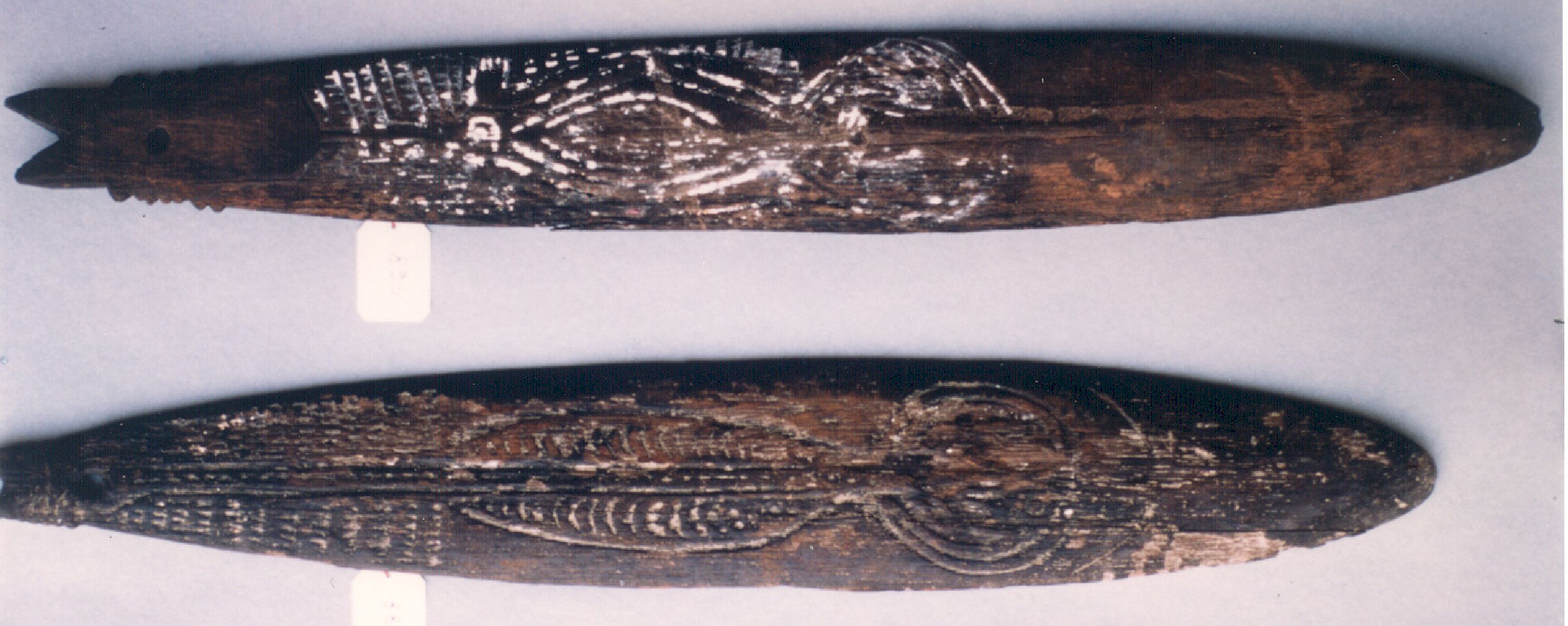
Poro ungapa
Poro ungapa: 'fraternalized and highly-honored slat of palm wood to which a long whip is tied'; twirled in a grand arc from a carrier stick, its roaring, screaming noise 'is regarded as the voice of the Poro spirit.' Ibaria and Inaru are the names of particular bullroarer traditions; Inaru is also the seafaring canoe from which certain people emerged to pursue their tradition in the Morobe area, and the original name of the Guhu-Samane people.
Among the Guhu-Samane of the Waria valley, inland from the government post of Morobe, the bullroarer announced the rites of poro, the men's cult that governed initiation, marriage, gardening, war and peace. The instrument — poro ungapa, a 'fraternalized and highly-honored' slat of palm wood — was ten or twelve inches long, normally kept in the mystical custody of the poro mothers; for a rite a designated priest lashed it to a fifteen-foot cord fixed to a slender pole of equal length and, wielding it like a supple whip, whirled it powerfully around his head to raise a siren-like wail — the roaring, screaming voice of the Poro spirit — calculated to drive fear and horror into the young women and children of the distant village. It also heralded the coming of an important man, so that of a notable person it was said his name had the quality of the bullroarer's call. Initiation was brutal: boys ran a gauntlet of glancing axe and club blows and had the nose septum and ear lobe pierced, and any who cried out were dealt a swift, lethal blow as unfit for male society, the body buried and the mother told only that the poro had eaten him. Survivors were then shown the men's other guarded voice, the sacred reed flutes played in matched pairs. The whole system was described to the SIL translator Ernest Richert by Bage, one of the last surviving priests, the cult having been discontinued about twenty-five years before.
O Lord, our Lord in all the great earth your name has the quality of the bull-roarer call.
Psalm 8:1 in Guhu-Samane, as given by Ernest L. Richert, 'How the Guhu-Samane Cult of Poro Affects Translation,' The Bible Translator 16 (1965), p. 85
Particulars
- Function
- Guhu-Samane poro bull-roarer used in initiation; normally held in mystical custody by poro mothers, then whirled by a priest to frighten young women and children and to announce an important person.
Source
K. A. Gourlay, Sound-Producing Instruments in Traditional Society (New Guinea Research Bulletin 60, 1975), Table 1, entry 62; Ernest L. Richert, 'How the Guhu-Samane Cult of Poro Affects Translation,' The Bible Translator 16 (1965), pp. 81-85; Ernest L. Richert and Ttopoqogo Hoopusu, Noo Supu: A Triglot Dictionary (SIL, 2002)