No. AUSIN-031
Willilambi boorbing and yeenma
Eucla · Twilight Cove · Western Australia
Restricted
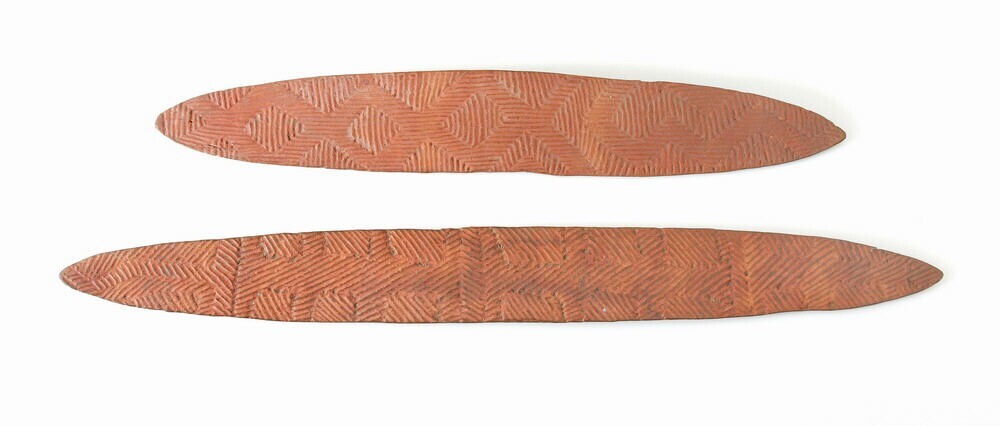
boorbing / yeenma
Source term: boorbing
boorbing: bull-roarer; yeenma: long carved hardwood boards (equated by Bates with Spencer's churinga), incised with the anatomy of the conquered eaglehawk.
Etymology. Bates' Willilambi/Twilight Cove text glosses boorbing as bull-roarer, distinguished from the longer carved yeenma boards.
In a star myth Daisy Bates collected from the Willilambi people near Twilight Cove, on the southern coast of Western Australia, the old men carve their sacred wood as a trophy of the eaglehawk they had conquered. From hardwood trees they make the long flat boards called yeenma, which Bates equated with Spencer's churinga, and the bull-roarers called boorbing, and onto the boards they cut the heart, ribs, stomach, entrails, and tail of the eaglehawk. The hardwood itself was moodiji, forbidden to the eaglehawk and reserved to the hardwood totem, so no eaglehawk could fashion such boards or spear-throwers from it. The eaglehawk Walja, whose fires lay far to the north, had been killing the Willilambi men's boys until two allied brothers, right-handed Badhu-wudha and left-handed Koorulba, killed him. When the eaglehawk, his woman, and their two boys went up into the sky they became what white men call the Southern Cross and the Pointers. The eaglehawk's heart and belly are still on the board in Bates's Eucla vocabulary, where a man named Karnduing explained the yinma markings as kurdudu and mugula — heart and belly — of the eaglehawk; and the board has a place in the sky as well as on the ground: at Eucla the dark patch in the Milky Way is the shadow of the yinma.
The old men made yeenma (long carved boards — Spencer's Churinga) and boorbing (bull-roarers) from the hard wood trees, and the carvings on the boards were the heart, ribs, stomach, entrails, and tail of the eaglehawk, whom they had conquered; and no eaglehawk could make spear-throwers or boards from the hard wood, for it was moodiji (forbidden) to them and belonged to the hardwood totem only.
Daisy Bates, "Aboriginal Stellar Myths," The Australasian, 26 July 1924
Particulars
- Object
- Bull-roarers (boorbing) and long carved hardwood boards (yeenma), incised with the eaglehawk's anatomy.