No. AUSMAIN-002
Kaitish (Kaytetye)
Sandover · Barrow Creek region · Central Australia
Restricted
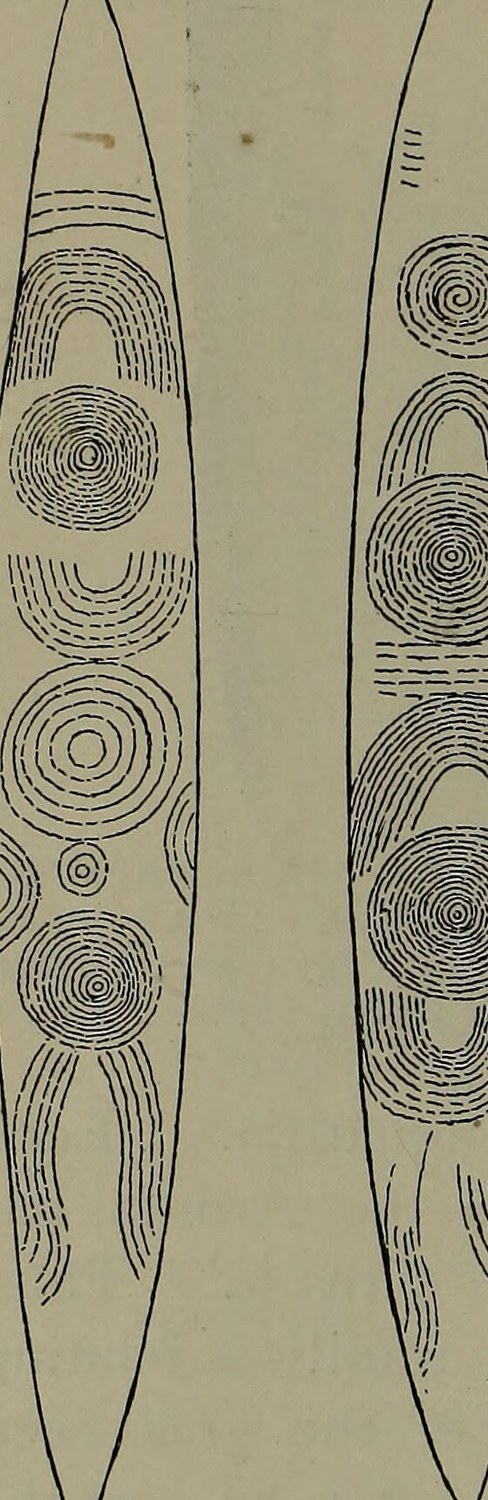
churinga
churinga — the Arunta name for the sacred stone or wooden object of Central Australian peoples, holding an ancestor's spirit-essence and equivalent to the bull-roarer.
Etymology. Churinga is an Arunta (Aranda) word used as a regional cover-label: a substantive for the stone or wooden slab and, adjectivally, "sacred" (as in aritna churinga, "sacred name"). The Kaitish own word for the object is allongalla.
The Kaitish tell how the churinga was invented. In the Alcheringa two men named Tumana, themselves sprung from churinga, heard far off the roaring that the sky-dweller Atnatu made twirling his own churinga, and set about imitating the sound: slats of bark failed, but a churinga cut from mulga wood roared. As they whirled it, the down flew from their bodies and fell to earth, and where it fell mulga trees sprang up — the trees from which churinga are cut to this day. The two inventors were killed by wild dogs, like the Warramunga's Murtu-murtu after them; but two men who had secretly watched taught the rest how to make and swing the churinga at initiation. The Kaitish churinga itself, Spencer and Gillen recorded, is not the symmetrical oval of the south but a flat, pear-shaped slab of micaceous stone with a lump of resin at its narrow end, reddened with ochre and painted in charcoal and pipe-clay; it holds the spirit-essence of an Alcheringa ancestor, and is kept from women and the uninitiated on penalty of death or blinding with a fire-stick. A stone of the same form, a strand of hair-string knotted into the resin, was gripped before the face and jerked three times toward the person it was meant to kill while an incantation was spoken.
In the case of the Kaitish and Warramunga tribes, which are located further to the north, the Churinga are distinct in shape from those of the Arunta. Each consists of a flat, micaceous slab, which in outline is characteristically pear-shaped, with always a small lump of resin affixed to the narrow end.
Spencer & Gillen, The Native Tribes of Central Australia (1899), ch. V (The Churinga or Bull-roarers of the Arunta and Other Tribes), pp. 156-157
Particulars
- Object
- Flat micaceous slab, pear-shaped with resin lump at narrow end; distinct from Arunta form.
- Function
- Stored ancestor-essence; whirled at initiation; cult-totem property.