No. PNG80
Awaiama and Taupota
Papua New Guinea · Milne Bay · Oceania · Sahul
Sacred / spirit
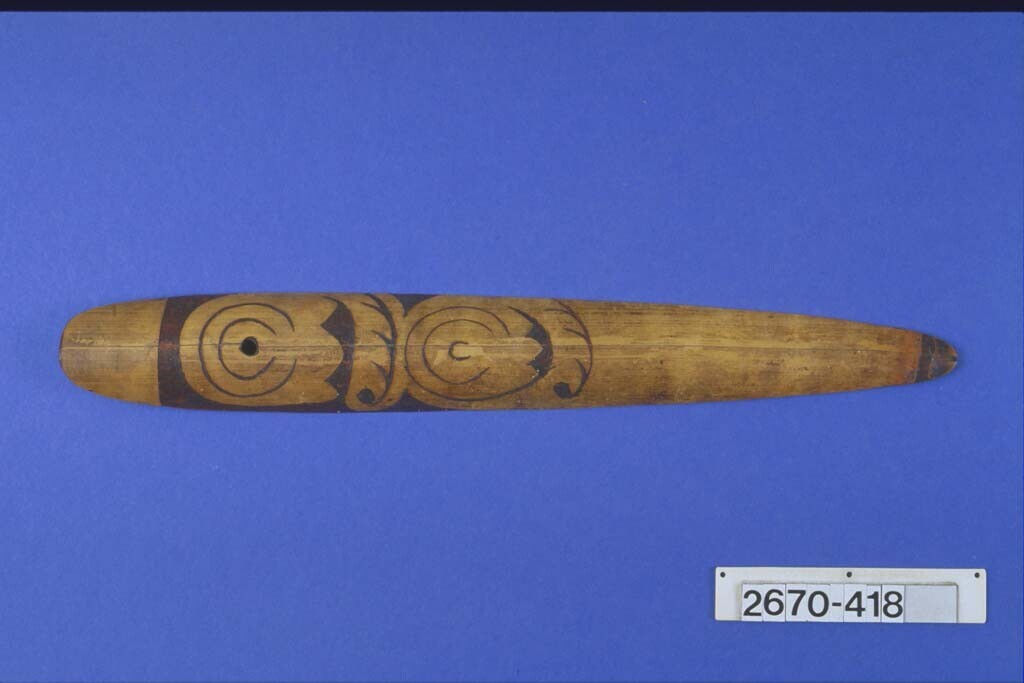
walaga = the raised wooden platform or feast-house built for the great mango feast at Bartle Bay; gweri ravai = ritual practitioners who officiated at the stepping of its posts.
At Awaiama and Taupota, east of Bartle Bay, the bull-roarer belonged to the walaga, the largest feast of the district, built around a great dancing platform raised on piles. As the fasting men stepped the supporting posts into their dug holes, they swung bull-roarers the whole time, while medicine men rubbed the posts and sucked loudly through their cupped hands to draw out the arua, the shade of any dead man that might be lodged in the timber, so the soul should not be injured when the post was erected. The roarers sounded for this moment alone, in a feast whose pigs were speared slowly so the mangoes would hear them squeal and be fruitful.
The gweri ravai [medicine men] then carried the soul away and released it in the grass or bush.
Seligman 1910, The Melanesians of British New Guinea, p. 592
Source
K. A. Gourlay, Sound-Producing Instruments in Traditional Society: A Study of Esoteric Instruments and Their Role in Male-Female Relations (New Guinea Research Bulletin 60; Canberra and Port Moresby, 1975), Table 1, entry 80; C. G. Seligman, The Melanesians of British New Guinea (Cambridge, 1910), pp. 592, 596; Gourlay 1975, Table 1, entry 79 (Awalama, i.e. Awaiama); Seligmann 1910, pp. 589-597 ('The Walaga Feast and the Cult of the Mango')