No. PNG78
Topura
Papua New Guinea · Milne Bay · Oceania · Sahul
Restricted
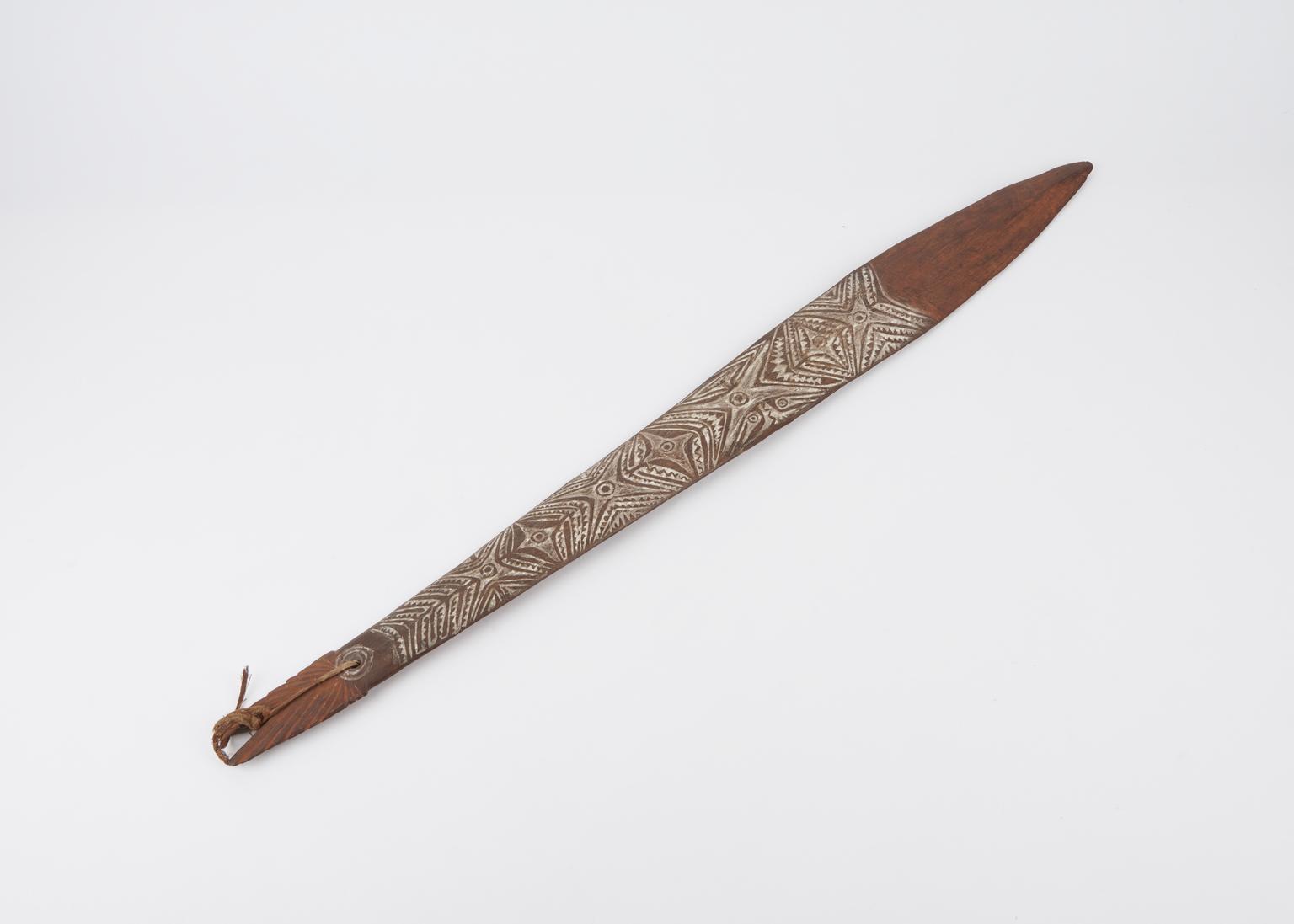
On this coast the bullroarer spoke for one act only. As the fasting men of Awaiama and Taupota, east of Bartle Bay near the island's far southeastern tip, planted the tall posts of the walaga — the grandest feast of the district, drawing in even hostile villages — they swung the roarers without pause, while medicine men crouched at every post-hole and sucked the shade of the dead out of the timber, so no lingering ghost would be crushed as the pile went down. Then the roarers stopped. They were used at no other time, Seligman was told, and no reason for them could be given.
Particulars
- Function
- Swung by the fasting men, set apart as holy, only while the walaga feast-platform posts were stepped.
Source
K. A. Gourlay, Sound-Producing Instruments in Traditional Society: A Study of Esoteric Instruments and Their Role in Male-Female Relations (New Guinea Research Bulletin 60; Canberra and Port Moresby, 1975), p. 3 and Table 1, p. 7, entry 78; C. G. Seligman, The Melanesians of British New Guinea (1910), pp. 589–592