No. PNG51
Kai
Papua New Guinea · Morobe · Oceania · Sahul
Restricted
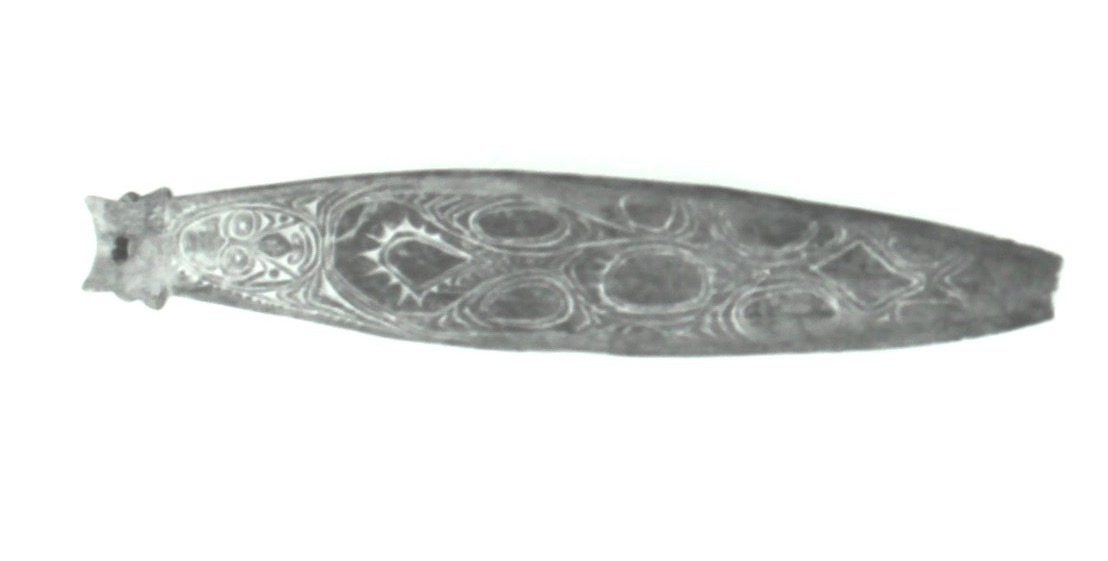
Ngosa
grandfather
Etymology. Among the Kai, Ngosa means "grandfather," and the same word names both the monster who swallows the novices at circumcision and the bull-roarers swung to voice him.
Among the Kai, a tribe of mountaineers inland from Finsch Harbour, the bull-roarer was the voice of Ngosa, the monster who swallowed boys at circumcision. The Kai conceived male initiation as being gulped down and disgorged by this being, and one word, Ngosa, named the monster, the swinging bull-roarer that gave him his droning voice, and—where the neighbouring Yabim, Bukaua and Tami used their cognate words for a ghost of the dead—the grandfather. In the Kai enactment the trembling novices were led in single file beneath a scaffold on which a man stood; as each boy passed under, the man made a gesture of swallowing and let a gulp of water descend on him in a jet, and only then did the cut of the circumcision knife follow, afterward explained as the bite the monster gave in spewing the boy back out. The instruments themselves were lance-shaped pieces of carved palm-wood, kept wrapped up in the men's house, which no woman might enter, and only the old men had the right to undo the bundles. Keysser reports that at one such Kai festival a woman who approached the forbidden forest village was caught, thrown into an old pig pit and trampled to death. The Kai say the thing was a woman's find first. Near Laugube, barely an hour's walk south of Sattelberg, a woman chopping firewood struck a flat stick that sprang up and flew whirring through the air. She brought the discovery to her brother, who saw at once what could be made of it — a huge pig feast, held at the women's expense — and the one obstacle in his way was that his sister knew. He told her what he intended, and she advised him, unselfishly, to kill her, so that the men's secret would keep.
It is highly significant that all these tribes of New Guinea apply the same word to the bull-roarer and to the monster, who is supposed to swallow the novices at circumcision, and whose fearful roar is represented by the hum of the harmless wooden instruments. Further, it deserves to be noted that in three languages out of the four the same word which is applied to the bull-roarer and to the monster means also a ghost or spirit of the dead, while in the fourth language (the Kai) it signifies "grandfather."
J. G. Frazer, The Golden Bough, abridged ed. (London, 1922), ch. 67
Particulars
- Object
- Lance-shaped Ngosa bullroarers carved from palmwood, 30–40 cm long, more or less richly decorated; pierced at one end, tied to a long cord and swung in a circle.
- Function
- Ngosa roarers sounded at circumcision initiation, where the namesake monster was said to swallow and release the novices.
Source
Ch. Keysser, "Aus dem Leben der Kaileute," in R. Neuhauss, Deutsch Neu-Guinea, vol. III (Berlin, 1911), pp. 34–37; J. G. Frazer, The Belief in Immortality, vol. I (London, 1913), pp. 290–291; J. G. Frazer, The Golden Bough, abridged ed. (London, 1922), ch. 67; K. A. Gourlay, Sound-Producing Instruments in Traditional Society (Canberra, 1975), pp. 70, 81–82