No. MUS2026-410Australia
The Rainbow Serpent going home
Australia
Function not recorded
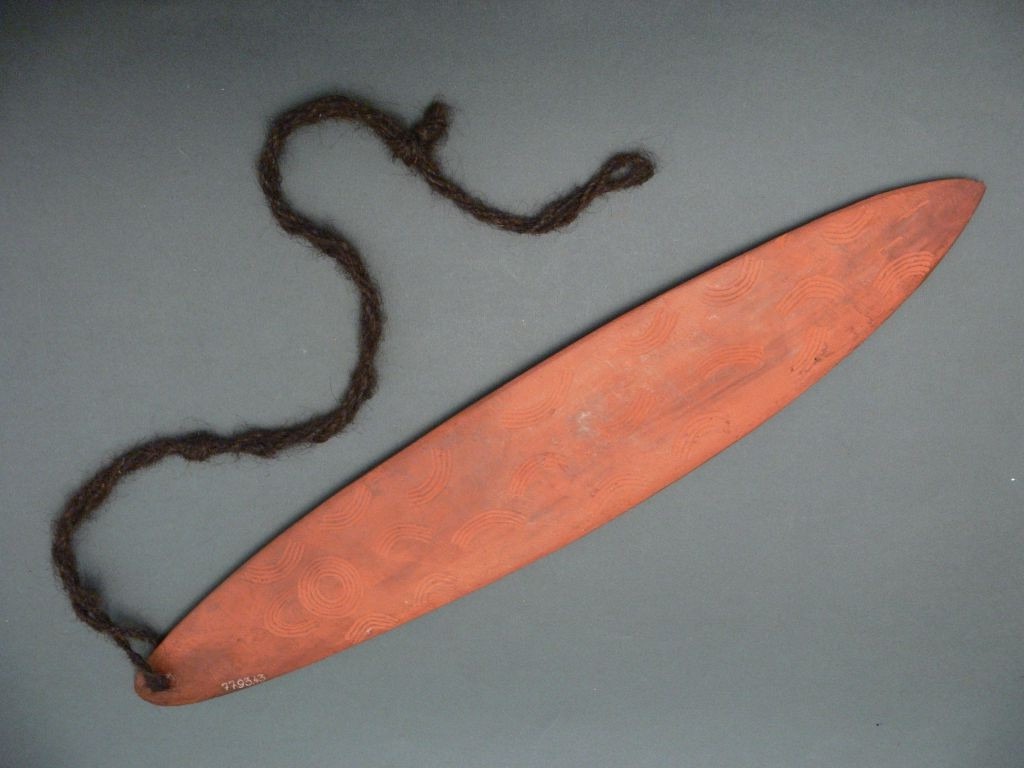
Source term: búgófa / zúgattyú (bullroarer)
búgófa, zúgattyú: Hungarian for bullroarer ('humming wood', 'whirrer').
Down one face of this red-rubbed blade runs a long wavy line, scored across in each trough with four short strokes, and at its end a set of concentric circles. The Budapest museum reads it as the Rainbow Serpent, so often depicted, travelling back to its mythical dwelling place. The other face belongs to the caterpillar ancestors: rows of arcs, each cut with four lines, and beside the circles at the cord end a half-circle, one of the ancestors seated at the place. The cord threaded through the hole is plaited from human hair.
Particulars
- Object
- An elliptical hardwood blade, 46.5 x 8 cm, ground smooth and rubbed with red paint, with a hair-string cord through a hole at one end. One face carries a long incised wavy line ending in concentric circles; the other, rows of arcs of four incised lines, with concentric circles and a half-circle at the cord end.
Source
Néprajzi Múzeum (Museum of Ethnography), Budapest, Oceania Collection, NM 77.93.43, 'Búgófa' (online object 101178591): hardwood, cord, paint; ground, incised, drilled; place of collection and use 'Ausztrália'; earliest year of use 1951. Catalogue description, after G. Wilhelm, Időképek, p. 396: "Ellipszis alakú, simára csiszolt fadarab vörös festékkel bedörzsölve; Egyik oldalára hullámvonalat karcoltak hosszában; Ennek egyik végén koncentrikus körminta látható. A hullámvonal mindegyik völgyében merőleges, négy egyenes karcolás van; A zugattyú másik oldalán négy karcolással készített ívek találhatók, az egyik végén koncentrikus körminta, alatta félkörív. Azon a végén, ahol a koncentrikus kör van, lyukat fúrtak, és hajból font zsinórt fűztek; A koncentrikus körhöz kapcsolódó hullámvonal feltehetően a nagyon gyakran ábrázolt szivárványkígyó, mely mitikus tartózkodási helyére tér vissza; Az ív alakú jelek a hernyó totem ősei, egyikük a koncentrikus kör formájú hely mellett ül, félkörívként megjelenítve."