No. MUS2026-271
Hackett's four Musgrave–Mann blades
South Australia · Musgrave and Mann Ranges · Central Australia
Restricted
Source term: Bullroarer
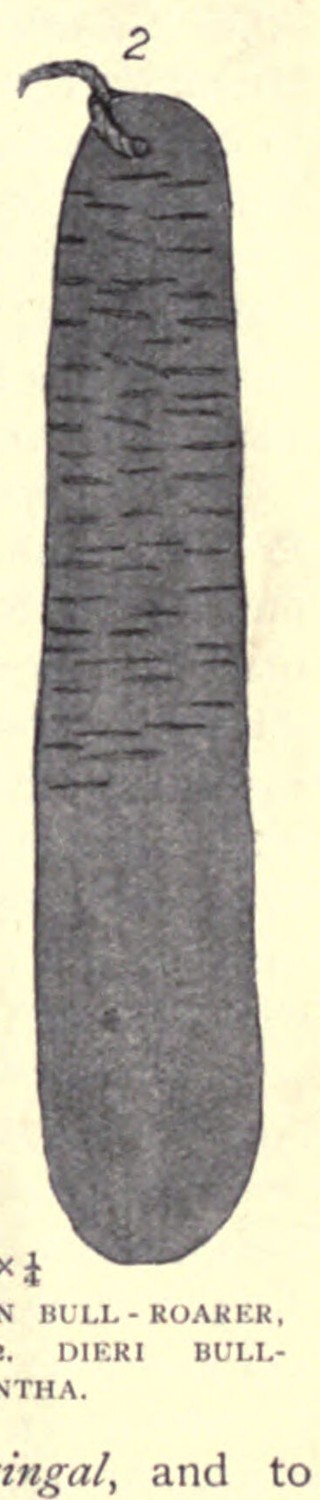
In the winter of 1933 Cecil Hackett went out on camels with Norman Tindale and spent two months in the Mann and Musgrave Ranges, travelling with some forty Pitjantjatjara who were moving east to a gathering at Ernabella. On that journey Tindale watched two young men through their initiation. An hour before daylight they rose and set off west with their guardians, swinging bull-roarers, on a long tour of the country beyond the Tomkinson Range, forbidden to speak. Later, camped near Mount Davenport, the party heard the howl of the roarers and saw torches glimmer as the youths came in to a rock hole for water. Every bright fire was dulled, and the women kept their faces down beside them. Four blades came back with Hackett. The best described is pocket-sized at 15.7 centimetres, incised and pigmented, on a brown cord.
Particulars
- Object
- Incised and pigmented wooden slat, 15.7 cm, with a brown cord.
- Function
- In the Mann and Tomkinson Ranges, newly circumcised youths set out before dawn on a long bush journey, swinging bull-roarers as they went and whenever they neared a waterhole, while the women kept their faces down so as not to see them.
Source
British Museum Oc1981,15.9–12; one Cecil John Hackett donation in 1981; four twentieth-century wooden bullroarers; .12 is 15.7 × 2.7 × 0.5 cm with incised design, pigment, and brown wool(?) cord; N. B. Tindale, "Initiation among the Pitjandjara natives of the Mann and Tomkinson Ranges in South Australia", Oceania 6 (1935), p. 220, as quoted in Géza Róheim, The Eternal Ones of the Dream (1945), p. 15