No. MUS2026-039
Wajarri churinga carved from shell
Murchison · Western Australia
Restricted
Churinga
Source term: bull-roarer
Churinga (Arrernte tjurunga): an Arrernte word for a sacred object; applied by the museum as a general classifier for this Wajarri specimen.
Etymology. Churinga is the Arrernte (Arunta) word meaning "sacred" or "secret," the name for a class of sacred wood and stone objects, the smaller wooden ones serving as bull-roarers. A Central Australian term, applied here by the museum to a Western Australian Wajarri specimen.
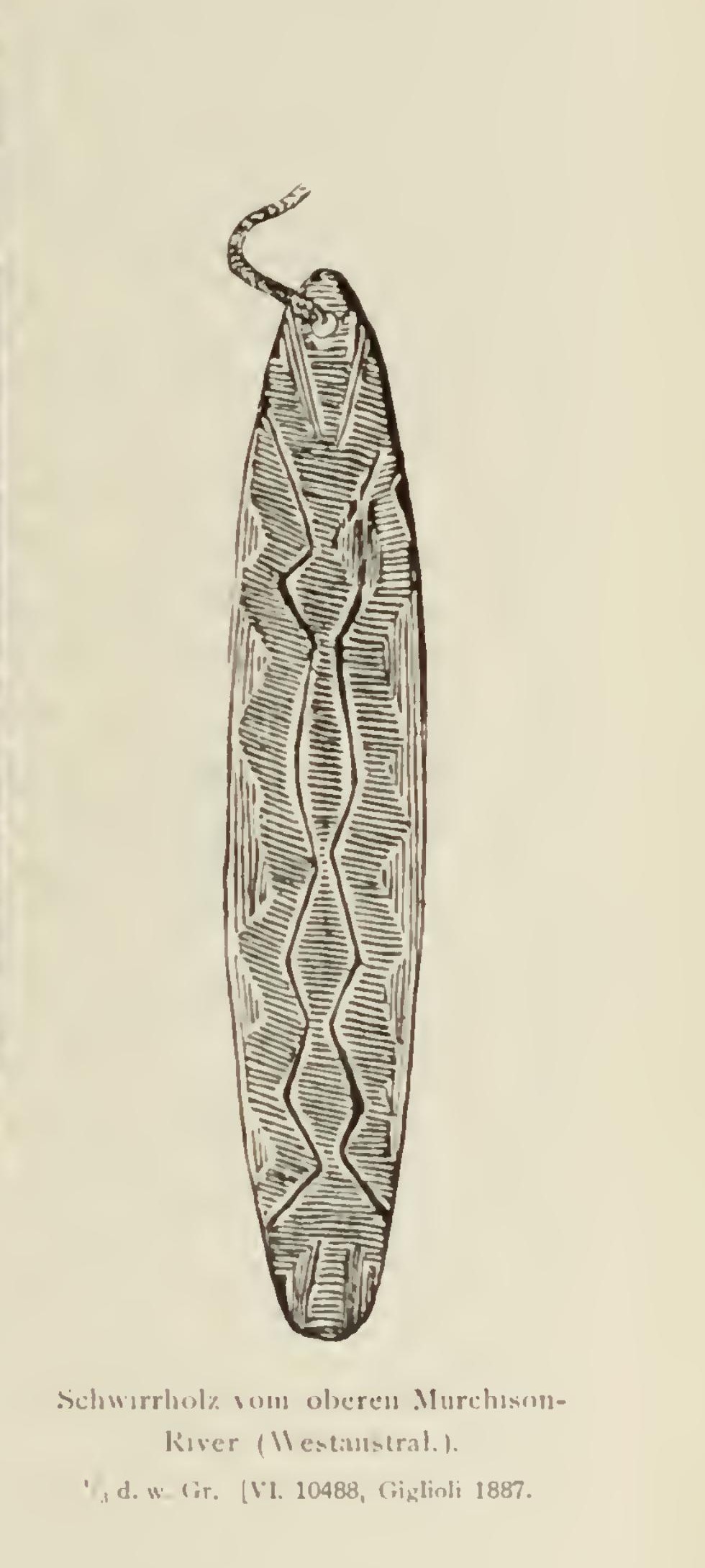
In Wajarri country in Western Australia’s Murchison, the bullroarer belonged to men’s ceremonial life. This one is cut from shell: an incised slip not twenty centimetres long, pierced for its cord. The blade pictured is a wooden one from the Upper Murchison, in Berlin since 1887: long zigzags run down its narrow face over dense parallel hatching, and a cord braided from human hair still hangs from its tip. Felix von Luschan, who published it in 1896, wondered whether those zigzags began as two human figures dancing a corroboree.
Churinga is the name given by the Arunta natives to certain sacred objects which, on penalty of death or very severe punishment, such as blinding by means of a fire-stick, are never allowed to be seen by women or uninitiated men.
Spencer & Gillen, The Native Tribes of Central Australia (1899), ch. V "The Churinga or Bull Roarers of the Arunta and Other Tribes"
Particulars
- Object
- A small bullroarer of shell, 197 by 35 millimetres, carved, incised and perforated. Another Wajarri-attributed blade in the Pitt Rivers Museum, 1926.70.8, is a giant: 767 by 73 millimetres, carved and incised, stained and pigmented, and pierced for its cord.
- Function
- A men's ceremonial object, one of a class of Australian churinga seen only by initiated men.