No. MUS2026-203
Sherlock River cora, the devil-scarers
Pilbara · Western Australia
Sacred / spirit
cora / bonangharry
Source term: devil scarer or bullroarer
cora / bonangharry (Clement's own spelling boonangharry; banangari in Radcliffe-Brown 1913): the Pilbara bullroarer, glossed 'devil-scarer' because it is swung to drive off the djuno, the evil spirit blamed for every illness and every death. A shared Ngayarta term.
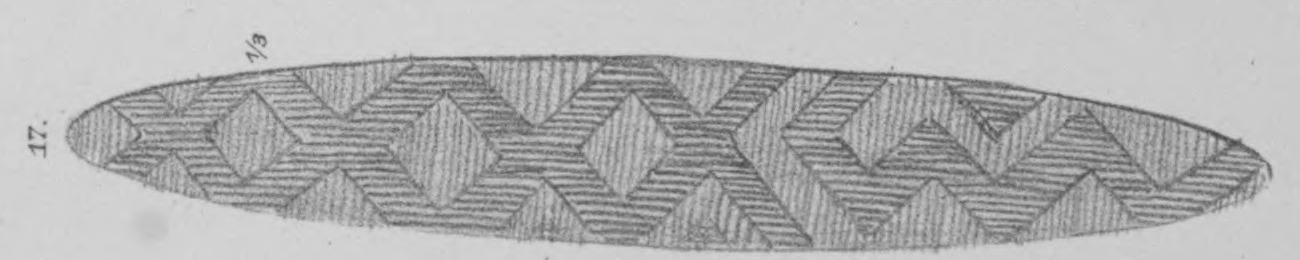
Zigzag bands cross each other down more than half of a thirty-two-centimetre blade of hard brown wood, one of three bullroarers Emile Clement took out of the Sherlock River district, the seam between Ngarluma and Kariyarra country. The other two came with it, one stained red and cut with a spine of eight branching grooves, one carrying three twice-curved incisions in the shape of a U beside a figure Clement's cataloguer could only describe as resembling a swastika. All three answered to the same double name, cora or bonangharry, and Clement translated the second word as devil-scarer. The djuno was the evil spirit, and it caused every illness and every death; there was no dying of natural causes. So the blades were set roaring over a sick man while the doctor stalked him in narrowing circles, and roaring again over a corpse, and roaring through every night of the month-long circumcision camp while the men danced the una and the old women danced the hibageh.
The boonangharrie's are swung to drive the djuno away, as he is the cause of death. They do not believe in death by natural causes.
Emile Clement, "Ethnographical Notes on the Western-Australian Aborigines," Internationales Archiv fuer Ethnographie 16 (1904), p. 8
Particulars
- Object
- Three cora from the Sherlock-district in Clement's Leiden collection. Item 147 (inv. 1207/14) is 32.5 x 5 cm, its zigzag bands crossing each other over more than half the blade; Plate IV fig. 17. Item 143 (inv. 1207/16) is 39.5 x 4.5 cm, an elliptic slat of hard brown wood, one side convex and one flat, stained red and grooved all over, the grooves forming a median band with eight branches running out to the edges. Item 145 (inv. 1207/15) is 36.5 x 4 cm, its grooves mostly zigzag and the pattern meanderlike, the convex side carrying three twice-curved incisions that form the letter U and, beside them, 'an incised figure similar to a svastica'. Two more Sherlock River blades under the same double name are in the Pitt Rivers Museum, Oxford: 1898.75.45, 51.8 by 4.5 centimetres of plain carved wood pierced for the cord, and 1898.75.46, longer and broader at 58.3 by 5.8 centimetres, its carved surface still holding pigment.
- Function
- Swung over the sick while the doctor circled the patient, swung at a death to drive off the djuno, and swung violently through the circumcision camp.
Source
J. D. E. Schmeltz, Ethnographica II: Sammlung Clement aus Nordwest-Australien, Internationales Archiv fuer Ethnographie 16 (1904), Group XI, items 143, 145, 147; Wereldmuseum (Rijksmuseum voor Volkenkunde) Leiden, inv. 1207/14, 1207/15, 1207/16. Function from Emile Clement, Ethnographical Notes on the Western-Australian Aborigines, same volume, pp. 8-11