No. MUS2026-078
Urama kaiaimunu, voices and mothers
Papua New Guinea · Gulf Province (Urama Island) · Oceania · Sahul
Restricted
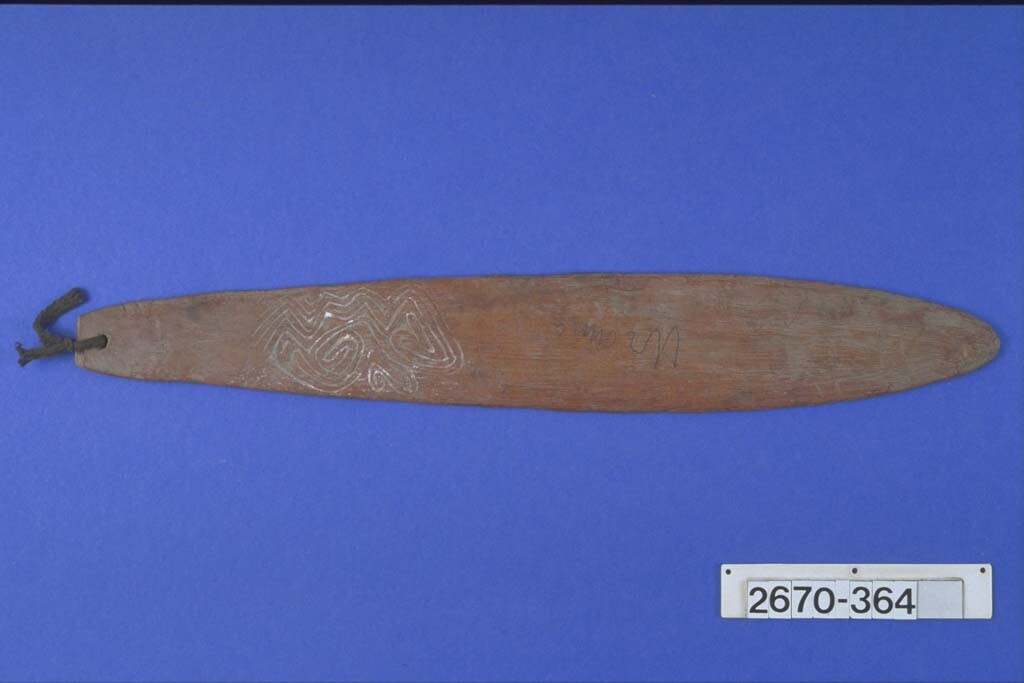
kaiaimunu
Source term: bull-roarer
Kaiaimunu names bullroarers in the Urama–Gope–Era region; Era basketry creatures share the name.
Etymology. Kaiaimunu names the bullroarer among Urama and neighbouring Gulf peoples. Era basketry creatures share the name and contain instruments as their voices. Schultze-Westrum distinguishes small sounding blades from powerful, secretly kept “mother” blades.
In the eastern Delta of the Papuan Gulf, among the Urama, only the small kaiaimunu were swung: plain blades that made the voice. The larger ones were their “mothers.” Wrapped in bundles of pandanus leaves, they lay on the floor behind the row of kope boards in the skull shrine, and they were very powerful: the older a bullroarer, the more it held of imunu, magical power of the highest quality. The mothers could be handled only by a few old men, in secret, and they never left the ceremonial longhouse. Along the Era River the same name belonged to huge basketry creatures that kept bullroarers inside as their voices.
The mothers can be handled only by some old men in secrecy
Thomas Schultze-Westrum, in Michael Hamson (ed.), Collecting New Guinea Art (2013)
Particulars
- Object
- Snorrebot / bull-roarer of the Urama, Wereldmuseum / NMVW TM-2670-364.
Sources
- Wereldmuseum, TM-2670-364 View
- Douglas Newton, Art Styles of the Papuan Gulf (1961), pp. 19–20 View · archived
- Paul Wirz, 'The Kaiamunu-Ebiha-Gi Cult in the Delta-Region and Western Division of Papua', JRAI 67 (1937), pp. 408–409 View · archived
- Thomas Schultze-Westrum, 'Bullroarers, Kaiaimunu', in Collecting New Guinea Art, ed. Michael Hamson (2013), pp. 187–188 View · archived