No. AUSMAIN-025
Mardu (Mardudjara) Western Desert sacred-board bullroarer
Western Desert of Western Australia, around Lake Disappointment (Kumpupintil) on the Little Sandy · Gibson Desert margins; people now centred on Jigalong
Restricted
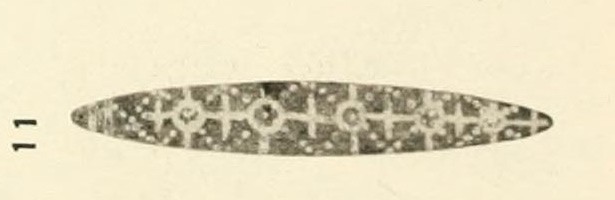
Source term: bullroarer-class sacred board
For the Mardu of the Western Desert, the world is the work of Dreaming beings who hunted and camped across it; when their wanderings ended they 'died' into landforms and celestial bodies, where their essence remains 'withdrawn from, but watchful of, human affairs.' They answer neither prayer nor sacrifice — only ritual, properly performed. The most sacred things a Mardu group owns are stones that are metamorphosed pieces of the beings' own bodies, and the incised wooden boards men carve after them, of the Western Desert bullroarer class. A youth is circumcised amid ceremony 'modeled symbolically on death and rebirth,' but the heart of his initiation is the Mirdayidi, a feast at his group's secret cache where the objects are revealed to him for the first time; in the final stage he learns to cut and carve them himself, on bush grounds tabooed to women and children.
The most sacred are stones said to be the metamorphosed parts of the bodies of ancestral beings and wooden boards that men carve in representation of similar power-laden objects that were carried by the creative beings.
Tonkinson, 'Mardu Religion,' Encyclopedia of Religion (1987; 2nd ed. 2005)
Particulars
- Object
- Power-laden wooden boards carved by Mardu men to represent sacred objects carried by creative beings — boards of the Western Desert bullroarer class.
- Function
- Sacred boards carved in representation of the power-laden objects the Dreaming beings carried; revealed to novices at the Mirdayidi and carved by them in the final initiation stage, on grounds tabooed to women and children
Source
Robert Tonkinson, 'Mardu Religion,' Encyclopedia of Religion (1987; 2nd ed. 2005), sections 'Life Cycle and Male Initiation,' 'Ritual' and 'Sites and Portable Objects'