No. NGUINEA-015
Ankave-Anga bullroarer (Suowi Valley)
Papua New Guinea · Southern Anga territory, northernmost Gulf Province at the Morobe · Eastern Highlands junction (Suowi-Mbwei Valley) · Oceania · Sahul
Restricted
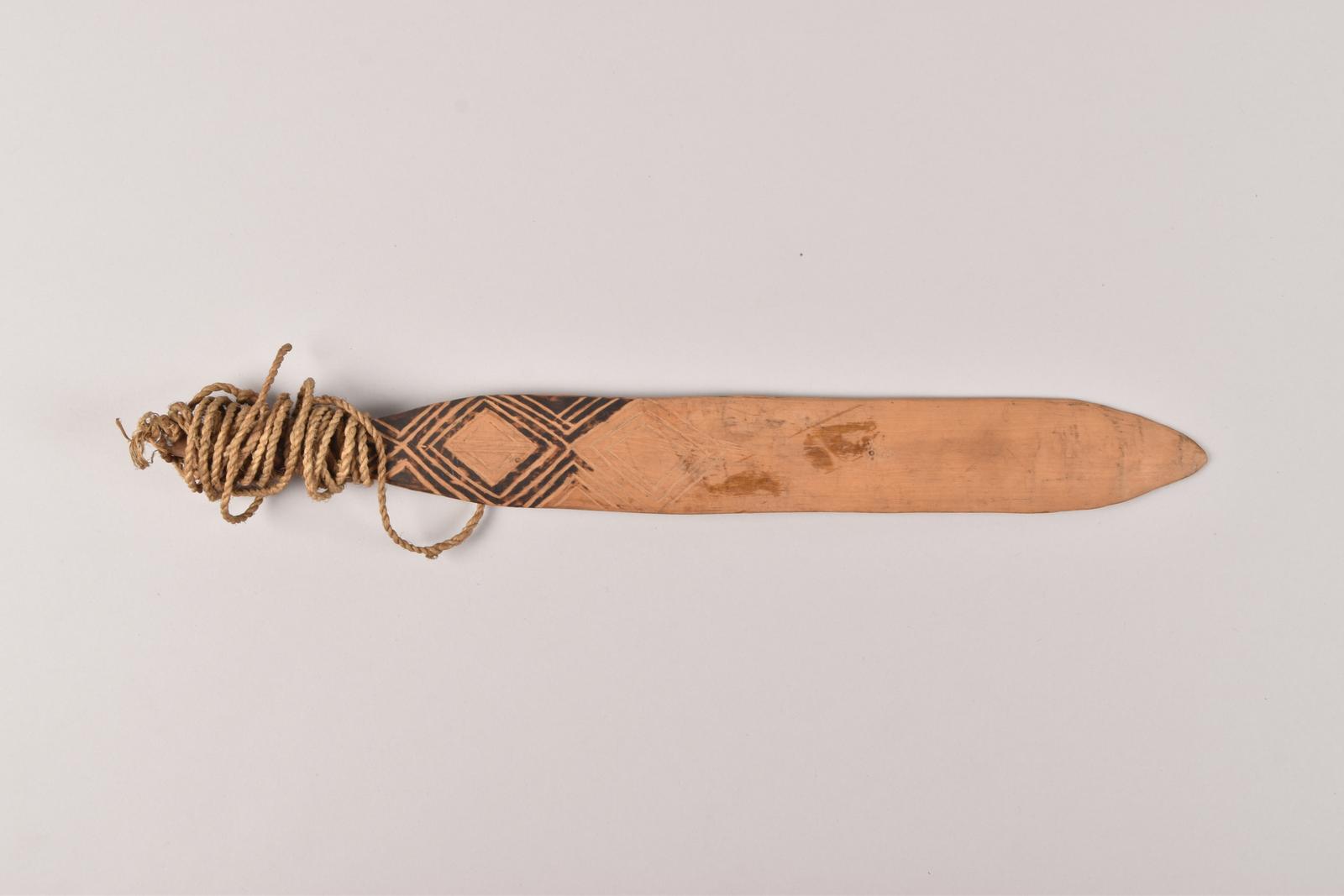
Source term: mautwa
"Bullroarer" in the neighbouring Kapau-Kamea (Kamea) language.
Among the Ankave-Anga of the remote Suowi Valley, in the foothills that fall away toward the Gulf of Papua, the anthropologist Pascale Bonnemère watched a boys' initiation from the women's side. While the men pierced the novices' septa in the forest, the secluded mothers and sisters flattened themselves on the ground under their bark capes, listening to "the words of the spirits, which we anthropologists know to be the sound of the bullroarers." Unlike the neighbouring Kapau-Kamea, among whom Beatrice Blackwood was told it meant death for a woman to see the instrument, the Ankave attach no such danger or myth to the bullroarer; here it concerns the women not at all, save as a voice heard at a distance.
A strange sound rose from the forest above the village; it was the humming of the bullroarers, which the women, it is said, take to be spirit voices.
Bonnemère, Acting for Others (2018), p. 81
Particulars
- Object
- A bullroarer that hums when whirled.
- Function
- Whirled by initiated men in the forest at the edge of the village during the boys' nose-piercing initiation; the secluded mothers and sisters, who hear but do not see, take the humming for the voices of spirits.
Sources
- Pascale Bonnemère, Acting for Others: Relational Transformations in Papua New Guinea, trans. Nora Scott (Chicago: HAU Books, 2018), pp. 81, 96, 106-108 View · archived
- Beatrice Blackwood, The Kukukuku of the Upper Watut, ed. C. R. Hallpike (Oxford: Pitt Rivers Museum, 1978), pp. 124, 158-159, quoted in Bonnemère (2018)
- Bamford (2004), cited in Bonnemère (2018), pp. 106-108