No. MUS2026-118
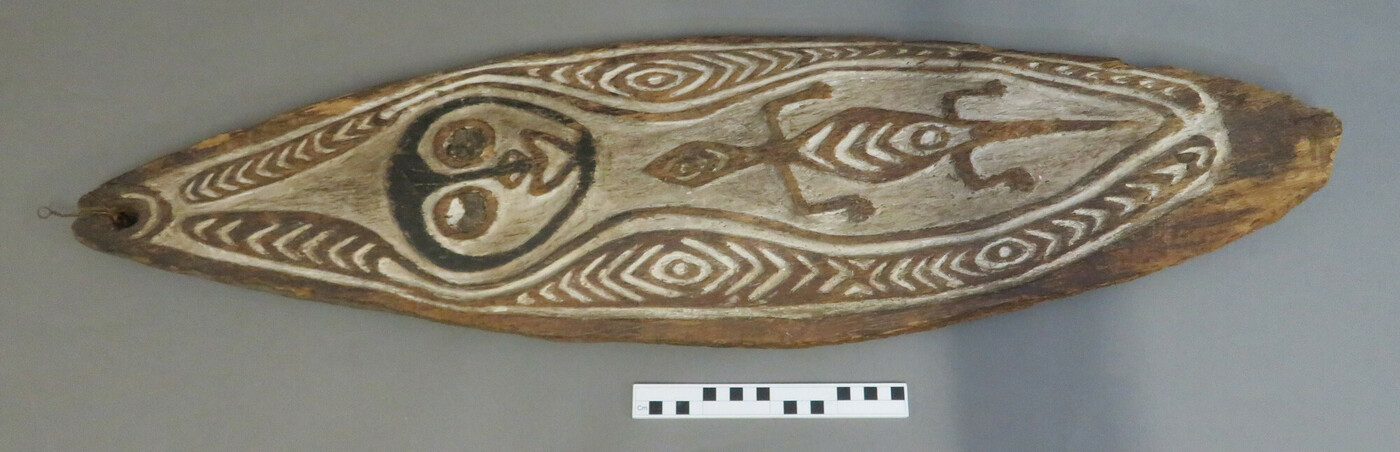
Koriki spirit-face and crocodile bull-roarer
Papua New Guinea · Purari Delta (Pai-i-ara), Gulf Province · Oceania · Sahul
Restricted
koe / kwoi
Source term: bull-roarer
koe / kwoi (koi): the Purari name for the flat painted spirit-face boards of the gope type, kin to the bull-roarer, imunu viki, "weeping spirit."
Etymology. In the Purari Delta the word koe (a transcription of koi/kwoi) names the flat, painted gope-type ancestor board — a plank carved with a spirit face that houses a clan's protective ancestral spirit. The bull-roarer was imunu viki, 'weeping spirit'; the board, Haddon suggested, was a bull-roarer grown huge.
In the Purari Delta the bull-roarer was called imunu viki, "weeping spirit": its whir was the voice of the imunu, the spirits, sounded at the initiation of boys and again at the deaths of important men, when the sound was heard as a lament. Among the Koriki, one of the Purari-speaking groups outsiders lumped together as the Namau, such bull-roarers belonged to the men's longhouse, the ravi, the ceremonial seat of the imunu. The spirit voiced in them was the kaiaimunu, the monstrous wickerwork being kept in the ravi, into whose jaws initiates were placed and from which they were said to emerge as men. Women and the uninitiated were kept from this board and from the source of its sound. A. C. Haddon, who worked the Papuan Gulf in 1914 and whose collection brought this board to Oxford, saw every gradation of size, form and decoration between such bull-roarers and the carved spirit-face tablets, koe, whose name it carries.
…carved and painted tablets, koe. These usually are pointed oval boards, one side of which is carved to represent a conventionalised human face and other designs, no two being alike…
A. C. Haddon, 'The Kopiravi Cult of the Namau, Papua', Man 19 (1919), no. 91, p. 177
Particulars
- Object
- An oval wooden board painted with a spirit face, a crocodile and bands of concentric circles; Pitt Rivers Museum, Oxford (acc. 1916.31.1; A. C. Haddon coll.).
- Function
- Whirled as the weeping voice of the imunu at boys' initiation and at the funerals of important men.