No. KABO1961-001Australia
Groote Eylandt face blade
Australia · Groote Eylandt, Gulf of Carpentaria, Northern Territory · Arnhem Land
Function not recorded
Source term: гуделка (bullroarer)
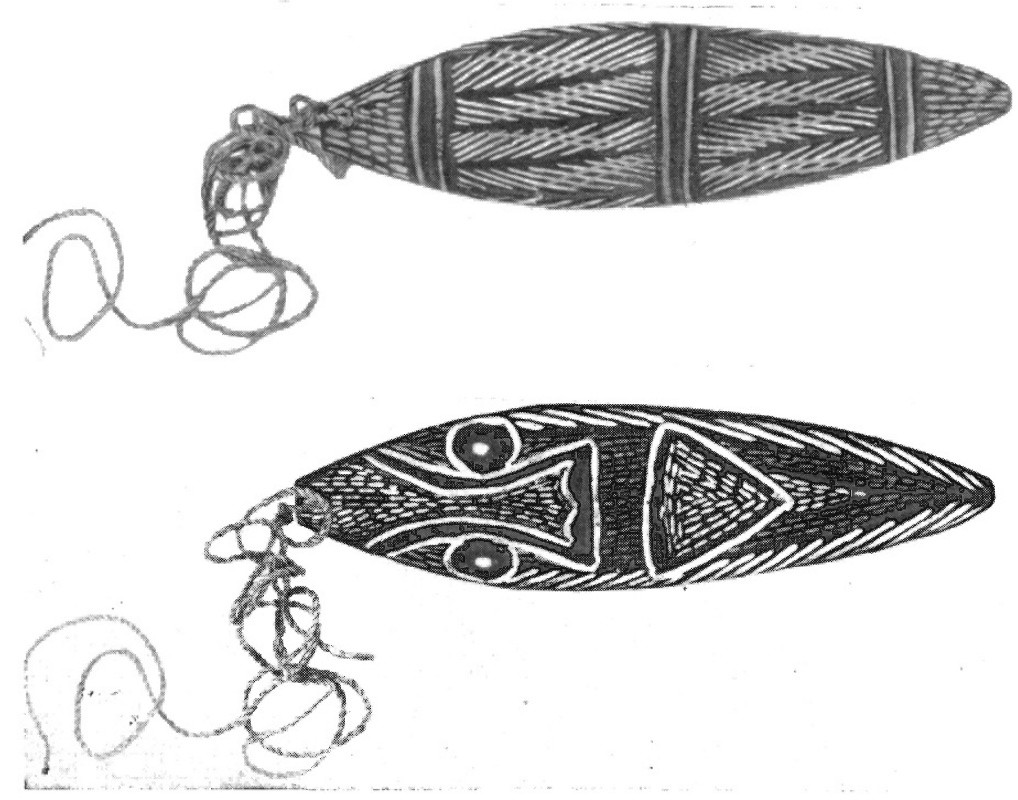
A face looks out from this small blade: round eyes ringed in white, a long nose running down between them, and a triangular mouth beneath, carved into the wood before it was painted, all set in fine white, yellow and red strokes. Faces are very rare on Australian bullroarers. Leonhard Adam, shown the piece, wrote that it was almost certainly made under New Guinea influence, and V. R. Kabo set it beside the faced blades of the Gulf of Papua, where the same eyes and nose stare from masks, shields and the boards of the men's houses. The anthropologist David Turner read the face on a second Groote blade differently, as a form of the East Wind design that belongs to the Mamariga clan. On the island itself, men carved boards picturing their dead in spirit form for the great remembrance rite, whose posts carried faces too, though cruder ones. The blade reached Leningrad in 1957, a gift from an Adelaide youth league handed over at the World Festival of Youth in Moscow.
Ваш образец почти несомненно обязан влиянию с Новой Гвинеи
Your specimen almost certainly owes its form to New Guinea influence
Leonhard Adam, letter quoted in V. R. Kabo, Sbornik MAE XX (1961), p. 167
One more plate
Particulars
- Object
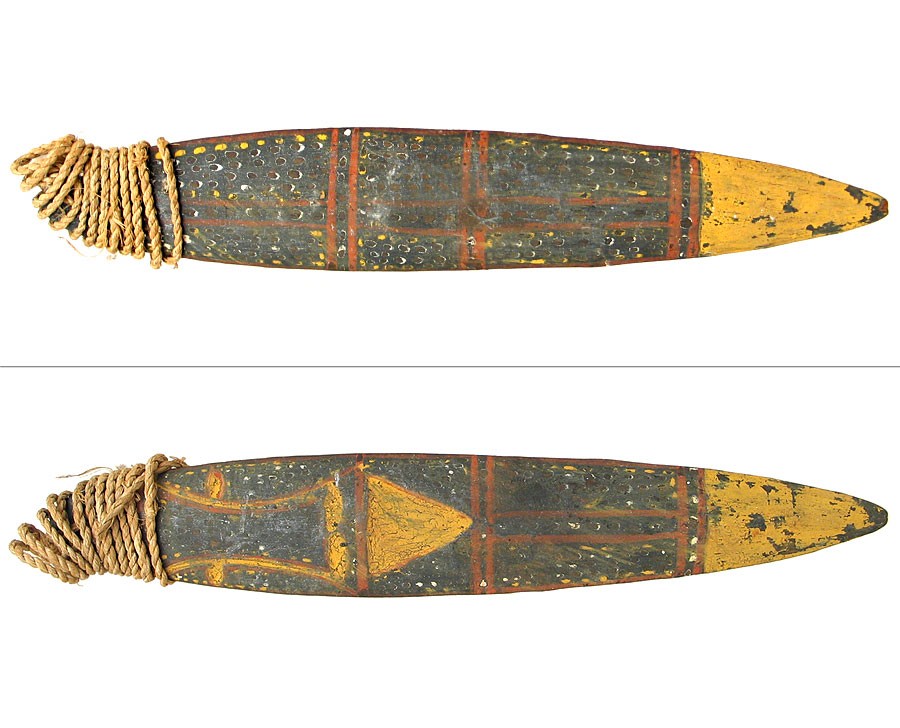
- Flat oval wooden blade, 22 by 6 cm, pierced at one end for its cord. One face carries the carved outline of a human face, picked out in red and white over a field of fine white, yellow and red strokes; the back bears cross-bands and crossing lines on black.
Discussed in one essay
 One Sahul
Sources
- V. R. Kabo, 'Kollektsiia s o. Grote Eilandt (Severnaia Avstraliia)', Sbornik Muzeia antropologii i etnografii XX (1961), pp. 166–171, plate 2 View
- David H. Turner, comments on a Groote Eylandt bull-roarer, quoted in a Duckdigital sale listing, 7 August 2005 View · archived
- David H. Turner, Tradition and Transformation: A Study of the Groote Eylandt Area Aborigines of Northern Australia (Canberra: Australian Institute of Aboriginal Studies, 1974), pp. 155–157 View
Nearby in the atlas
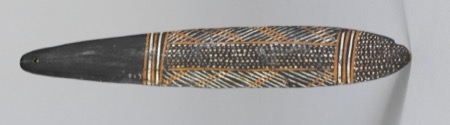 Warnindhilyagwa blade of totemic motifsAustralia · Groote Eylandt, Arnhem Land, N · Function not recorded
 Alawa dudugulindjiAustralia · Southern tributaries of the Roper River, upstream of the Hodgson River mouth, Northern Territory · Function not recorded
 Burarra maralbindiAustralia · Coast on both sides of the Blyth River mouth, east to Cape Stewart, north-central Arnhem Land, Northern Territory · Function not recorded
 Djinang maralbindiAustralia · Crocodile Islands and Milingimbi south to the middle Blyth River and east to the Glyde River, north-central Arnhem Land, Northern Territory · Function not recorded
 Djinba malaidjaraAustralia · Inland from the northern Arafura Swamp to the upper Goyder River, central Arnhem Land, Northern Territory · Function not recorded
 Gunwinggu gubarAustralia · Western Arnhem Land stone country, Liverpool River to Oenpelli (Gunbalanya), Northern Territory · Function not recorded